CIPS L5M5 Managing Ethical Procurement and Supply is a core module of the CIPS Level 5 Advanced Diploma in Procurement and Supply, worth 6 credits. It is assessed by a 1.5-hour objective-response (multiple-choice) exam. It teaches you to explain how ESG (Environmental, Social, and Governance) considerations can influence the ethical and sustainable elements of procurement and supply arrangements.
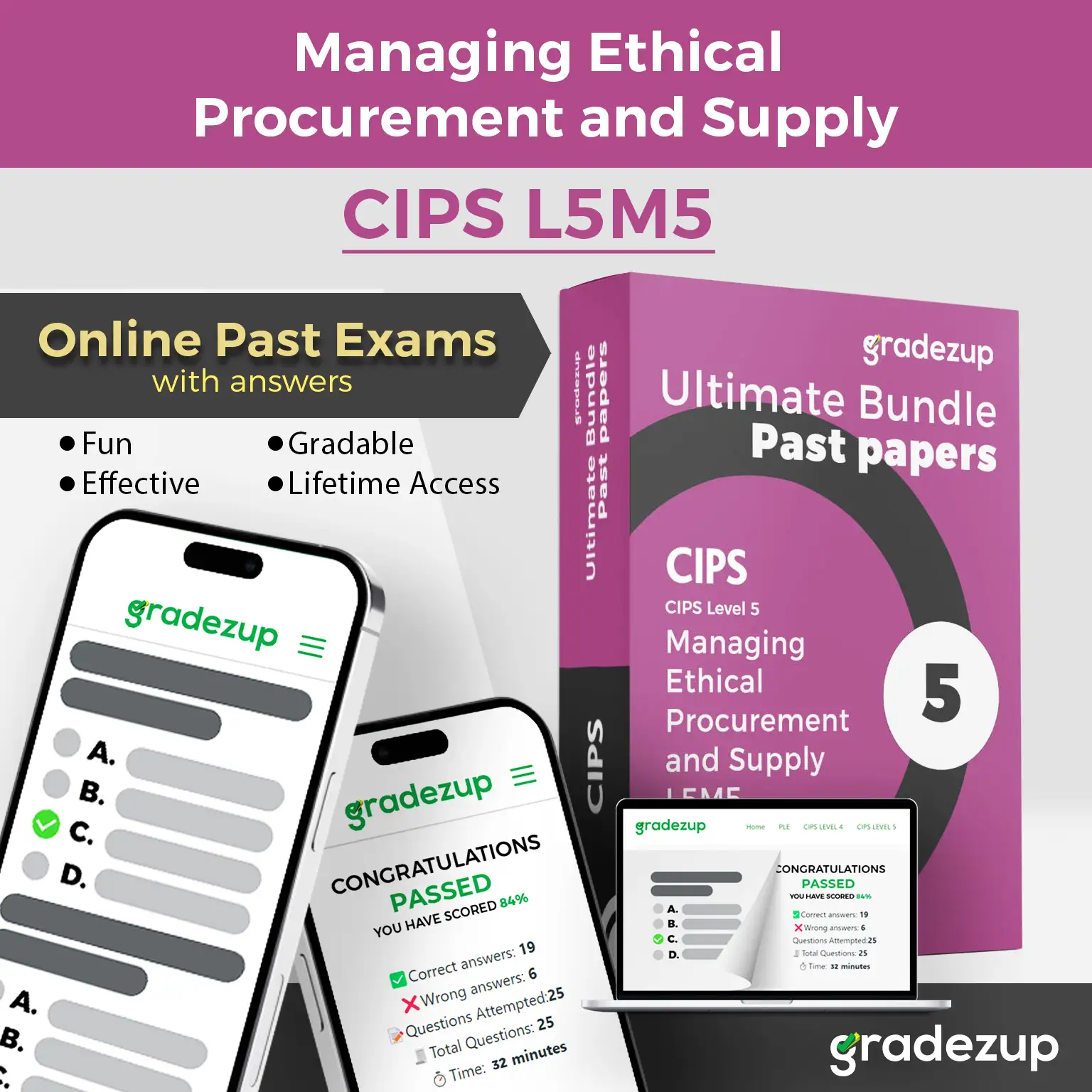
Prepare for the CIPS Diploma in Procurement and Supply with ease. Failing and retaking exams can be costly, but fret no more. Our meticulously crafted set of questions is designed to assist you in acing your exam on your first attempt. This bundle includes lifetime access to newly uploaded papers.
Already purchased but can’t access your course? Restore access
Your papers live in your account, so the first step is to sign in — using the same email address you paid with. If you checked out as a guest and have never made an account, create one on that address and everything you bought appears automatically.
The official L5M5 syllabus has 3 learning outcomes. Every Gradezup L5M5 paper is written to these outcomes and their assessment criteria.
1.0 Understand the impact of ESG (Environmental, Social, and Governance) considerations on ethical and sustainable supply chains
1.1
Analyse the application of ethical and ESG (Environmental, Social, and Governance) factors in supply chains Key topics (9)
Principles and application of ESG (Environment, Social, and Governance) considerations to secure ethical and sustainable procurement and supply arrangements
The role of environmental considerations in securing ethical and sustainable procurement and supply arrangements
The role of social value considerations in securing ethical and sustainable procurement and supply arrangements
The role of governance considerations in securing ethical and sustainable procurement and supply arrangements
The risks and rewards of adopting ESG (Environmental, Social, and Governance) considerations in securing ethical and sustainable procurement and supply arrangements
The development of ESG (Environmental, Social, and Governance) focused procurement and supply policies in securing ethical and sustainable procurement and supply arrangements
Role ofequality, diversity, and inclusion (ED&I) in securing ethical and sustainable procurement and supply arrangements
Issues impacting ethical and sustainable procurement and supply: modern slavery, bribery, corruption, fraud, and human rights infringements
Impact of breaches of ethical codes or ESG standards on reputation and brand
1.2
Contrast the factors influencing globalisation in supply chains Key topics (4)
Use of STEEPLED analysis to explain the factors driving globalisation
Competitive advantage through global sourcing
Low-cost country sourcing
ESG (Environmental, Social, and Governance) considerations in global sourcing
1.3
Assess the cultural and social factors in securing ethical and sustainable procurement and supply Key topics (5)
Language and culture
Labour standards and working practices
Wages and social security arrangements
Workers' rights
Health and safety standards
1.4
Contrast the potential conflicts between stakeholders that may arise from using ESG (Environmental, Social, and Governance) considerations in developing ethical and sustainable procurement and supply arrangements Key topics (6)
Profit maximisation and low-cost sourcing
Demand management and the need for urgent orders
Short-term commercial gains and long-term availability
Specifications
Responsible use of power relationships
Comprehensive stakeholder consultations and engagement
2.0 Understand the importance of compliance with ESG (Environmental, Social, and Governance) factors to achieve ethical and sustainable procurement and supply arrangements
2.1
Assess methods to achieve ESG (Environmental, Social, and Governance) standards to secure ethical and sustainable supply chains Key topics (4)
Mapping supply chains to achieve supply chain transparency
Analysis of ESG (Environmental, Social, and Governance) and ethical considerations to secure ethical and sustainable procurement and supply arrangements
Use of risk mitigation strategies to achieve ESG (Environmental, Social, and Governance) objectives to secure ethical and sustainable procurement and supply arrangements
Mapping, consulting, and managing all stakeholder requirements to secure ESG (Environmental, Social, and Governance) considerations in ethical and sustainable procurement and supply arrangements
2.2
Evaluate how contractual terms can support the achievement of ESG (Environmental, Social, and Governance) objectives for ethical and sustainable procurement and supply Key topics (3)
Monitoring contract performance
The importance of data and feedback from stakeholders to achieve compliance
Methods to correct non-compliance and create and monitor action plans
2.3
Evaluate the use of third-parties to promote compliance with ESG (Environmental, Social, and Governance) considerations in supply chains Key topics (3)
Sourcing third parties for auditing services
Assessing the competencies of third-parties for the provision of ethical and ESG (Environmental, Social, and Governance) audit services
Challenges with third-party auditors
2.4
Assess how supplier relationships should be managed in the event of failures in ESG (Environmental, Social, and Governance) considerations in ethical and sustainable procurement and supply arrangements Key topics (4)
Creating awareness of standards and updates to standards with suppliers
Worker representation, processes, and audit trails
Creating corrective action plans and supplier development programmes
Escalating non-compliance and making exit arrangements
3.0 Understand initiatives and standards related to ESG (Environmental, Social, and Governance) that support ethical and sustainable procurement and supply
3.1
Assess the role of international labour standards and independent external accreditations in achieving ESG (Environmental, Social, and Governance) considerations for procurement and supply Key topics (3)
Standards set by the United Nations (UN) and the International Labour Organization (ILO)
The role of the UN and ILO in pursuing improved ESG (Environmental, Social, and Governance) and ethical standards
Labour codes of conduct: Ethical Trading Initiative (ETI) and Social Accountability International's standard SA8000
3.2
Analyse how external environmental standards frameworks and external accreditations can help to achieve ESG (Environment, Social, and Governance) objectives in ethical and sustainable procurement and supply arrangements Key topics (2)
The benefits and challenges of independent standards in securing ESG (Environmental, Social, and Governance) objectives for ethical and sustainable procurement and supply arrangements
Role of industry standards and frameworks used by organisations in securing ESG Environmental, Social, and Governance) considerations and ethical standards
3.3
Analyse how standards can help to achieve fair trade in ethical and sustainable procurement and supply arrangements Key topics (5)
Principles of fair trade in procurement and supply
The World Fair Trade Organisation (WFTO) and its principles and charter of fair trade and implications for procurement and supply
Fairtrade International (FI), global fair trade organisations and their implications for procurement and supply
Fairtrade standards that affect the workplace and producers and their implications for procurement and supply
Importance of updating internal governance standards
From the official CIPS L5M5 syllabus.
Peer Review Dashboard NEW
Review other students' quiz submissions and track your own submission status across all quizzes.
Guest Access: You can review 1 submission and vote on 1 poll per month. Sign in for full access.
Submissions Available for Review
Select a submission from any quiz to claim and review. You cannot review your own submissions.
CIPS L5M5 Managing Ethical Procurement and Supply is a core module of the CIPS Level 5 Advanced Diploma in Procurement and Supply, worth 6 credits. It is assessed by a 1.5-hour objective-response (multiple-choice) exam. It teaches you to explain how ESG (Environmental, Social, and Governance) considerations can influence the ethical and sustainable elements of procurement and supply arrangements.
Is L5M5 a core or elective module?
L5M5 is a core module of the CIPS Level 5 Advanced Diploma in Procurement and Supply, worth 6 credits.
What type of exam is L5M5?
L5M5 is assessed by a 1.5-hour objective-response exam made up of multiple-choice questions.
What is the L5M5 pass mark?
You need 70% to pass an objective-response exam.
How many L5M5 practice papers are there?
Gradezup has 18 timed L5M5 practice papers with 426+ questions, written to the official syllabus, each marked the moment you submit with an explanation for every answer. At least one paper is free to try, no payment needed.
Are these the official CIPS L5M5 past papers?
No. CIPS does not publish its live exam papers. Gradezup papers are original exam-style practice papers written to the official L5M5 syllabus and modelled on the style and difficulty of the real exam.
What do I get when I enrol?
18 timed practice papers, 426+ exam-standard questions in total, each one auto-marked the moment you submit, with a worked answer and the reasoning behind every option. Your scores are tracked across attempts so you can see what is improving.
Do I have to work through the papers in order?
No. Every paper in CIPS L5M5 Managing Ethical Procurement and Supply unlocks as soon as you enrol, so you can start wherever you are weakest and retake any paper as often as you like.
How long do I have access?
Access does not expire. Once you enrol the course stays on your account, including any papers added to it later.
Can I pause a paper and finish it later?
Yes. Any paper can be paused mid-attempt and resumed from the same question, which makes short practice sessions workable.
What device do I need?
Any device with a browser — desktop, tablet or phone. There is nothing to install and nothing to download.
How close are these to the real CIPS level 5 exam?
Every paper is written against the current CIPS level 5 syllabus and mirrors the structure, question style and difficulty of the real exam, so practising here rehearses the exam itself rather than the topic in the abstract.
What is peer review?
Written answers cannot be auto-marked, so this course lets you submit yours for review by other learners working the same papers — and review theirs. Marking someone else against the rubric is usually the fastest way to see what an examiner is looking for.




Reviews
There are no reviews yet.