Original price was: $ 19.00.$ 4.99Current price is: $ 4.99.
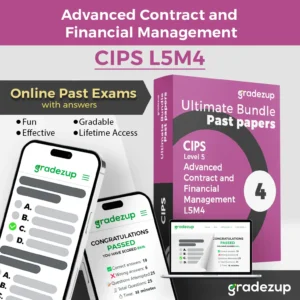
Prepare for the CIPS Diploma in Procurement and Supply with ease. Failing and retaking exams can be costly, but fret no more. Our meticulously crafted set of questions is designed to assist you in acing your exam on your first attempt. This bundle includes ย lifetime access to newly uploaded papers.
Lifetime access
This course includes
- 📝21 timed practice papers
- ✓475+ exam-standard questions
- ⚡Instant auto-marking & worked answers
- ⏸Pause & resume any paper
- 📊Track your scores over time
- 📱Works on any device
Already purchased but can’t access your course? Restore access
Loading polls...
What the L5M2 syllabus covers
The official L5M2 syllabus has 3 learning outcomes. Every Gradezup L5M2 paper is written to these outcomes and their assessment criteria.
1.0 Understand the nature of risk affecting supply chains
-
1.1
Analyse the different types of risk that can impact on supply chains
Key topics (6)
- Definition of risks; hazards; exposure; and risk appetite
- Categories of risk: financial, strategic, operational, and hazard
- ESG (Environmental, Social, and Governance) risks impacting supply chains
- Tools for assessing internal and external sources of risk
- Positive and negative consequences of risk
- Direct and indirect losses
-
1.2
Assess operational risks in supply chains
Key topics (8)
- Contract failure
- Financial risks: currency, cash flow and insolvency
- Quality failure
- Security of supply
- Technology
- Logistics complexity
- Risks in outsourcing and offshoring
- ESG (Environmental, Social, and Governance) risks impacting supply chains
-
1.3
Compare methods for eliminating fraud and corruption in supply chains
Key topics (4)
- Types of corruption
- Types of fraud
- Governance of fraud and corruption in supply chains
- The use of ethical codes including the CIPS Code of Conduct to support the elimination of risk
-
1.4
Assess the risks in supply chains that can impact on organisational ESG (Environmental, Social, and Governance) considerations
Key topics (5)
- Defining ESG (Environmental, Social, and Governance) considerations in the context of sustainable procurement and supply
- How environmental supply chain risks impact organisational ESG (Environmental, Social, and Governance) considerations.
- How social supply chain risks impact organisational ESG (Environmental, Social, and Governance) considerations
- How governance supply chain risks impact organisational ESG (Environmental, Social, and governance) considerations.
- Standards for sustainable procurement: ISO standards, United Nations (UN) and International Labour Organization (ILO), and local sustainability standards
2.0 Understand processes in managing risk in supply chains
-
2.1
Examine the use of contractual terms to help manage risk in supply chains
Key topics (5)
- Purpose and use of model form contracts in managing supply chain risk
- Purpose and development of indemnity and liability clauses in supply chain risk management
- Purpose and use of clauses for testing, inspection, and acceptance
- Impact of force majeure clauses in managing supply chain risk
- Global sourcing considerations and compliance to standards
-
2.2
Analyse the use of third-parties in risk management in supply chains
Key topics (3)
- Use of third-party providers for credit rating, debt factoring, and related business services in managing supply chain risk
- Use of third-party providers for auditing risks including ESG risks in supply chains
- Use of third-party providers for disaster recovery services
-
2.3
Assess the use of insurances for supply chain risks
Key topics (4)
- Use of insurance in managing supply chain risk
- Legal principles of insurance
- Categories of insurance: employers and public liability, professional indemnity, product liability, and trade credit
- Insurance claims, underwriting, and supply chain risk management
-
2.4
Examine the use of contingency plans in response to risks in supply chains
Key topics (3)
- Components of a business continuity plan and disaster recovery plan
- Definitions and purpose of disaster recovery and business continuity planning
- Importance of reviewing and testing contingency plans
3.0 Understand risk mitigation strategies in supply chains
-
3.1
Evaluate the use of probability and impact assessments to manage risks in supply chains
Key topics (4)
- Methodologies for assessing the probability and impact of risk
- Vulnerability assessments
- Collating statistical evidence of risks
- Use of probability theory and statistical distribution methods to determine the likelihood of risk
-
3.2
Analyse and propose how risk assessments and risk registers can mitigate risks in a supply chain
Key topics (3)
- Creation and use of templates for risk assessments and risk registers
- Engaging stakeholders in the development and review of risk assessment and registers
- Importance of reporting and action plans in risk management
-
3.3
Explain the development of a risk management culture and strategy to improve supply chains
Key topics (5)
- Developing a strategic approach to risk management
- Role of organisation culture in management of supply chain risk
- Risk management process and the development of risk management plans
- Resource requirements for effective supply chain risk management
- Supply chain risk visibility and reporting to stakeholders
From the official CIPS L5M2 syllabus.
Peer Review Dashboard NEW
Review other students' quiz submissions and track your own submission status across all quizzes.
Submissions Available for Review
Select a submission from any quiz to claim and review. You cannot review your own submissions.
Community polls
Loading polls...
Frequently asked questions
What is CIPS L5M2?
CIPS L5M2 Managing Supply Chain Risk is a core module of the CIPS Level 5 Advanced Diploma in Procurement and Supply, worth 6 credits. It is assessed by a 1.5-hour objective-response (multiple-choice) exam. It teaches you to evaluate a variety of tools and techniques to establish the level of risk in supply chains and to recommend and apply ways of avoiding, mitigating, or managing risk.
Is L5M2 a core or elective module?
L5M2 is a core module of the CIPS Level 5 Advanced Diploma in Procurement and Supply, worth 6 credits.
What type of exam is L5M2?
L5M2 is assessed by a 1.5-hour objective-response exam made up of multiple-choice questions.
What is the L5M2 pass mark?
You need 70% to pass an objective-response exam.
How many L5M2 practice papers are there?
Gradezup has 21 timed L5M2 practice papers with 475+ questions, written to the official syllabus, each marked the moment you submit with an explanation for every answer. At least one paper is free to try, no payment needed.
Are these the official CIPS L5M2 past papers?
No. CIPS does not publish its live exam papers. Gradezup papers are original exam-style practice papers written to the official L5M2 syllabus and modelled on the style and difficulty of the real exam.
What do I get when I enrol?
21 timed practice papers, 475+ exam-standard questions in total, each one auto-marked the moment you submit, with a worked answer and the reasoning behind every option. Your scores are tracked across attempts so you can see what is improving.
Do I have to work through the papers in order?
No. Every paper in CIPS L5M2 Managing Supply Chain Risk unlocks as soon as you enrol, so you can start wherever you are weakest and retake any paper as often as you like.
How long do I have access?
Access does not expire. Once you enrol the course stays on your account, including any papers added to it later.
Can I pause a paper and finish it later?
Yes. Any paper can be paused mid-attempt and resumed from the same question, which makes short practice sessions workable.
What device do I need?
Any device with a browser โ desktop, tablet or phone. There is nothing to install and nothing to download.
How close are these to the real CIPS level 5 exam?
Every paper is written against the current CIPS level 5 syllabus and mirrors the structure, question style and difficulty of the real exam, so practising here rehearses the exam itself rather than the topic in the abstract.
What is peer review?
Written answers cannot be auto-marked, so this course lets you submit yours for review by other learners working the same papers โ and review theirs. Marking someone else against the rubric is usually the fastest way to see what an examiner is looking for.
Questions from students
No questions yet โ ask the first one.
You must be logged in to ask a question.


Reviews
There are no reviews yet.