1 free to try · 1 of 15 unlocked — enrol to open the rest
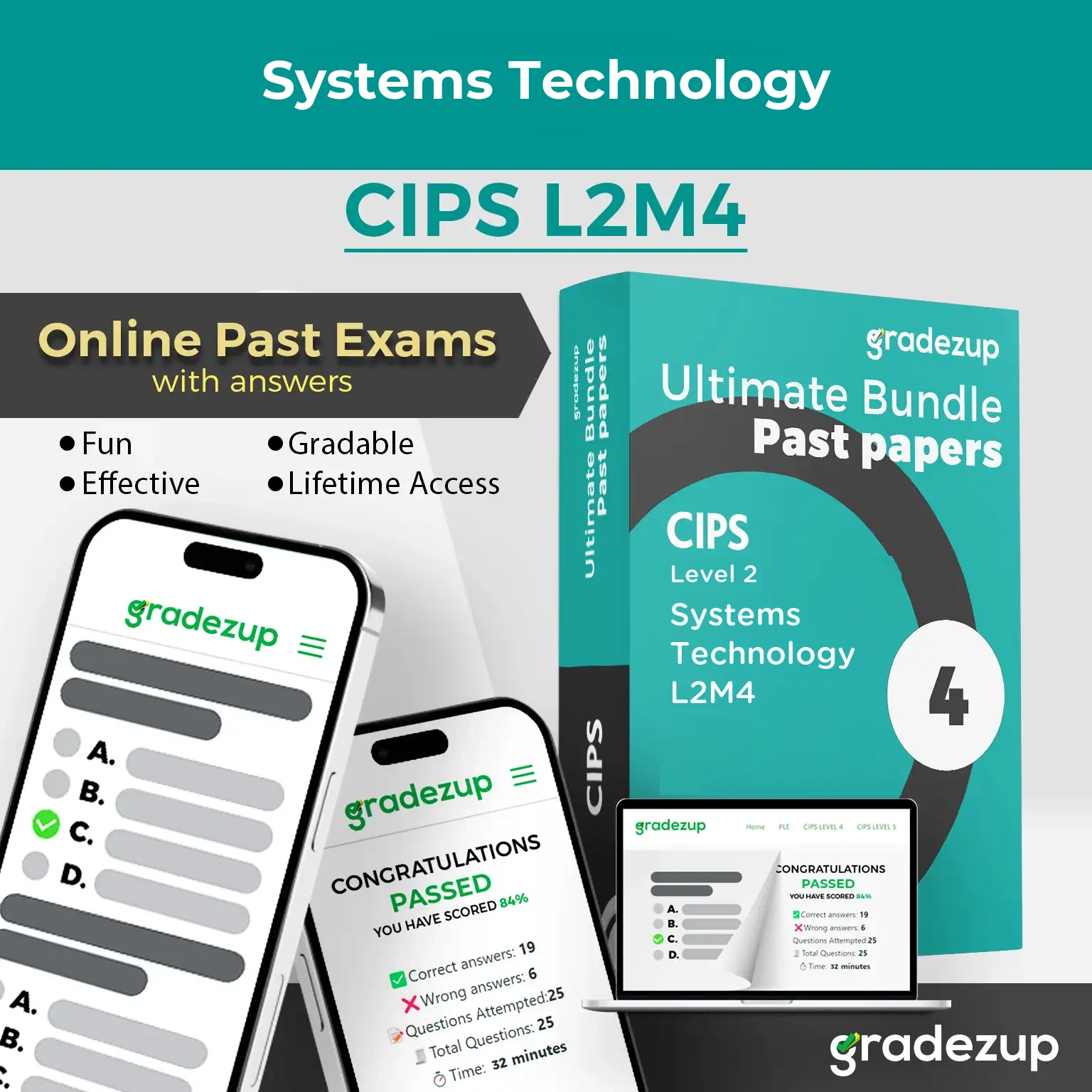
CIPS level 2
$ 9.99
What you will get
- Detailed explanations for every answer
- Instant feedback and scoring
- Practice on any device, anytime
- Full access with your Gradezup plan
📲 Join our free WhatsApp channel: an exam question every day.
This course includes
- 📝15 timed practice papers
- ✓375+ exam-standard questions
- ⚡Instant auto-marking & worked answers
- ⏸Pause & resume any paper
- 📊Track your scores over time
- 📱Works on any device
Already purchased but can’t access your course? Restore access
Your papers live in your account, so the first step is to sign in — using the same email address you paid with. If you checked out as a guest and have never made an account, create one on that address and everything you bought appears automatically.
Community polls
Vote to see how other learners answered.
Loading polls...
What the L2M4 syllabus covers
The official L2M4 syllabus has 3 learning outcomes. Every Gradezup L2M4 paper is written to these outcomes and their assessment criteria.
1.0 Understand the use of systems technology and databases and how they contribute to procurement and supply
-
1.1
Explain how to use systems technology and databases to contribute to effective procurement and supply
Key topics (8)
- Inputting of data to systems to perform key tasks for purchase ordering and other transactions
- Capturing data on expenditures and updating systems
- How to provide data to smooth demand and why demand management is important in procurement and supply
- Data use in the forecasting process
- Achieving functional targets
- How to compare forecasts with actual outcomes to control expenditures
- How to measure achieved savings of goods and services to recognise efficiencies
- How to measure internal and external lead times of supplies of goods and services
-
1.2
Recognise how the use of the Internet, intranets and extranets leads to effective procurement and supply
Key topics (4)
- The use of Internet search engines to locate details about suppliers and customers
- The types of information presented by suppliers and customers on their websites
- The e-market place
- The use of social media to obtain feedback on supplier performance
-
1.3
Explain the role of e-sourcing and e-tendering systems in procurement and supply
Key topics (4)
- E-invoicing, e-requisitioning, e-catalogues and e-ordering
- Pre-qualify suppliers
- Receive and evaluate quotations and tenders
- Defining e-sourcing
2.0 Know types of systems for supplier selection, ordering and payment
-
2.1
Describe the use of electronic sourcing systems for supplier selection and profiling
Key topics (3)
- Attracting quotations or tenders through an e-tendering or e-sourcing system
- The publication of e-notices
- The use of e-auctions
-
2.2
Identify systems used in procurement and supply
Key topics (4)
- Systems for purchase ordering
- Capturing data on expenditures
- The use of portal sites to locate suppliers or customers
- Examples of supplier database systems
-
2.3
Identify the use of P2P (purchase to pay) systems for ordering from suppliers and payment to suppliers
Key topics (2)
- The P2P process from the creation of requisitions, to raising requests for quotations or tenders, receipt of quotations or tenders, delivery documentation, invoicing and payment
- Examples of P2P systems
3.0 Know why quality management is important in procurement and supply
-
3.1
Identify components of quality management in procurement and supply
Key topics (3)
- Definitions of quality, quality control, quality assurance and total quality management
- Quality as a philosophy
- Getting things right first time
-
3.2
Identify the costs of quality
Key topics (3)
- Prevention and appraisal costs
- The internal and external costs of quality
- Organisational reputation
-
3.3
Identify techniques associated with quality assurance and quality management
Key topics (5)
- How to assess the quality of supplies of goods and services to ensure that quality standards are achieved and maintained
- From quality inspection to quality assurance
- Quality circles
- The use of control charts
- Kaizen, continuous improvement, lean philosophy and associated techniques
From the official CIPS L2M4 syllabus.
Peer Review Dashboard NEW
Review other students' quiz submissions and track your own submission status across all quizzes.
Submissions Available for Review
Select a submission from any quiz to claim and review. You cannot review your own submissions.
Loading available submissions...
Please sign in to view and create your polls.
Community polls
Loading polls...
Frequently asked questions
What is CIPS L2M4?
CIPS L2M4 Systems Technology is a core module of the CIPS Level 2 Certificate in Procurement and Supply Operations, worth 3 credits. It is assessed by a 1-hour objective-response (multiple-choice) exam. It teaches you to define the uses of, and identify the advantages offered by systems technology in improving procurement and supply activity whilst maintaining overall quality.
Is L2M4 a core or elective module?
L2M4 is a core module of the CIPS Level 2 Certificate in Procurement and Supply Operations, worth 3 credits.
What type of exam is L2M4?
L2M4 is assessed by a 1-hour objective-response exam made up of multiple-choice questions.
What is the L2M4 pass mark?
You need 70% to pass an objective-response exam.
How many L2M4 practice papers are there?
Gradezup has 15 timed L2M4 practice papers with 375+ questions, written to the official syllabus, each marked the moment you submit with an explanation for every answer. At least one paper is free to try, no payment needed.
Are these the official CIPS L2M4 past papers?
No. CIPS does not publish its live exam papers. Gradezup papers are original exam-style practice papers written to the official L2M4 syllabus and modelled on the style and difficulty of the real exam.
What do I get when I enrol?
15 timed practice papers, 375+ exam-standard questions in total, each one auto-marked the moment you submit, with a worked answer and the reasoning behind every option. Your scores are tracked across attempts so you can see what is improving.
Do I have to work through the papers in order?
No. Every paper in CIPS L2M4 Systems Technology unlocks as soon as you enrol, so you can start wherever you are weakest and retake any paper as often as you like.
How long do I have access?
Access does not expire. Once you enrol the course stays on your account, including any papers added to it later.
Can I pause a paper and finish it later?
Yes. Any paper can be paused mid-attempt and resumed from the same question, which makes short practice sessions workable.
What device do I need?
Any device with a browser — desktop, tablet or phone. There is nothing to install and nothing to download.
How close are these to the real CIPS level 2 exam?
Every paper is written against the current CIPS level 2 syllabus and mirrors the structure, question style and difficulty of the real exam, so practising here rehearses the exam itself rather than the topic in the abstract.
What is peer review?
Written answers cannot be auto-marked, so this course lets you submit yours for review by other learners working the same papers — and review theirs. Marking someone else against the rubric is usually the fastest way to see what an examiner is looking for.
Questions from students
No questions yet — ask the first one.
You must be logged in to ask a question.
Reviews
There are no reviews yet.