
1 free to try · 1 of 15 unlocked — enrol to open the rest
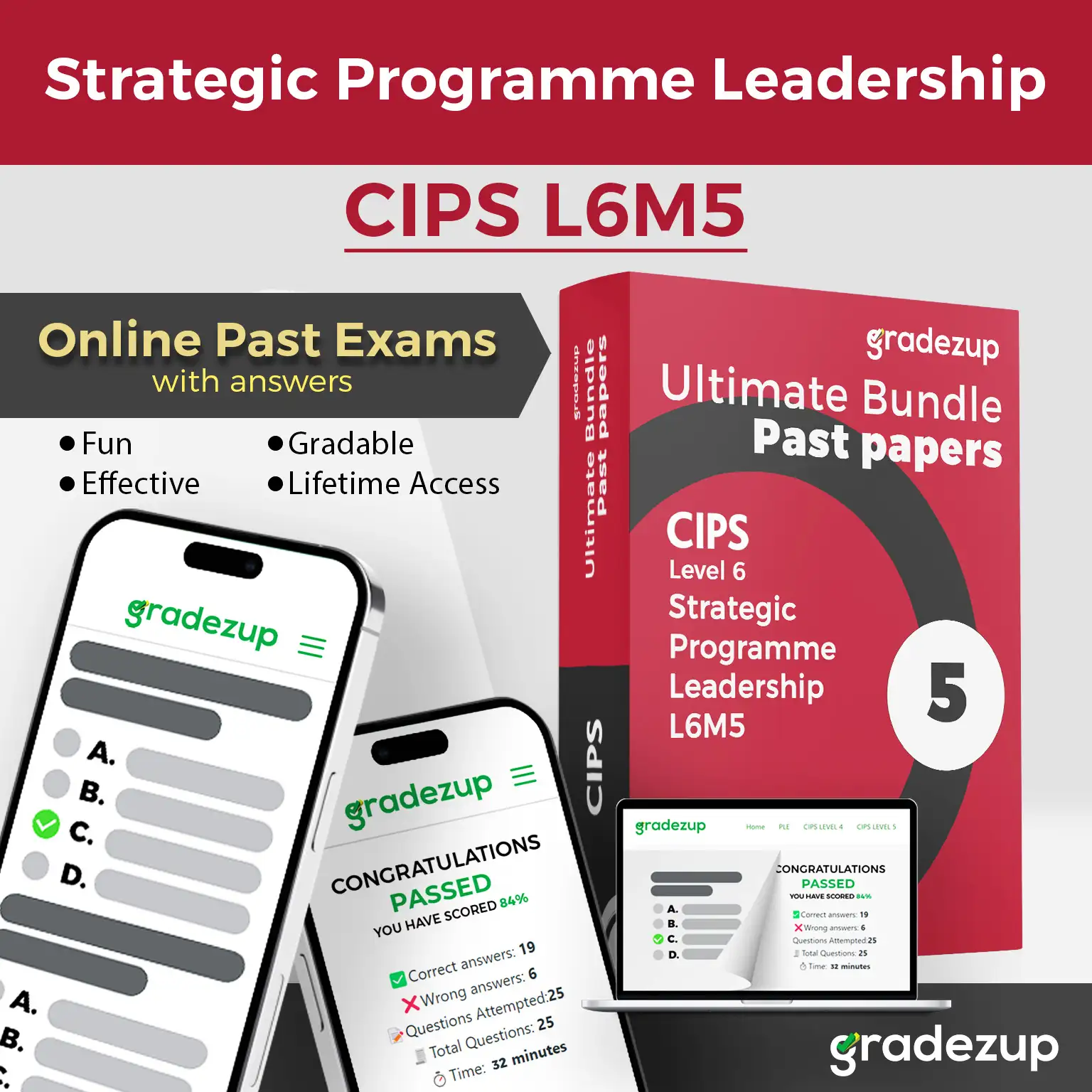
CIPS for level 6
Original price was: $ 9.99.$ 4.99Current price is: $ 4.99.
What you will get
- Detailed explanations for every answer
- Instant feedback and scoring
- Practice on any device, anytime
- Full access with your Gradezup plan
📲 Join our free WhatsApp channel: an exam question every day.
This course includes
- 📝15 timed practice papers
- ✓375+ exam-standard questions
- ⚡Instant auto-marking & worked answers
- ⏸Pause & resume any paper
- 📊Track your scores over time
- 📱Works on any device
Already purchased but can’t access your course? Restore access
Your papers live in your account, so the first step is to sign in — using the same email address you paid with. If you checked out as a guest and have never made an account, create one on that address and everything you bought appears automatically.
Community polls
Vote to see how other learners answered.
Loading polls...
What the L6M5 syllabus covers
The official L6M5 syllabus has 3 learning outcomes. Every Gradezup L6M5 paper is written to these outcomes and their assessment criteria.
1.0 Understand contracting for programmes
-
1.1
Compare contracting options for programmes
Key topics (5)
- Client coordinated approaches to major projects
- Engineering, procurement and construction (EPC)/ design and build forms of contract
- Management contracting and construction management
- Design, build, operate and ownership forms of contract
- Public and private sector partnerships
-
1.2
Evaluate contract forms for programmes
Key topics (2)
- The role of institutes and professional bodies in developing contract forms: The New Engineering Contract (NEC) core and optional clauses; International Federation of Consulting Engineers (FIDIC) contract forms; Institution of Mechanical Engineers (IMechE) contract forms; Joint Contracts Tribunal (JCT) contract forms; CIPS model forms of contract
- Comparisons of main contractual terms and schedules
-
1.3
Assess the use of pricing mechanisms for programmes
Key topics (5)
- Fixed lump sum pricing
- Activity schedule pricing
- Bills of quantity
- Target costing methods and risk and reward pricing mechanisms
- Cost reimbursable contracts
-
1.4
Contrast methods of investment appraisal for programmes
Key topics (8)
- Purpose of investment appraisal
- Payback analysis
- Average rate of return
- Discounted cash flow
- The choice of discount factor
- Calculating net present values
- Calculating the internal rates of return
- The strengths and weaknesses of different methods of investment appraisal
2.0 Understand programme leadership approaches
-
2.1
Assess approaches to strategic cost management for programmes
Key topics (5)
- Fixed and variable pricing methods
- Budgetary control and variance analysis
- Value engineering
- Consortium-based procurement
- The use of open book costing and cost transparency
-
2.2
Analyse the use of financial and management information on the performance of programmes
Key topics (5)
- Estimating budgets for projects
- Measurement, monitoring control and improvement
- Project tracking and control mechanisms
- Controlling variations, claims/compensation events
- Implementing remedial actions
-
2.3
Analyse the impact of programme performance on the supply chain
Key topics (5)
- Consequential losses resulting from default
- Assessment of damages
- Contractual warranties and conditions
- Specific performance
- Termination clauses
-
2.4
Assess the implications of programme closure on the supply chain
Key topics (5)
- Obtaining client acceptance
- Installing deliverables
- Conducting project audits
- Knowledge management
- Communicating the review, evaluation and learning
3.0 Understand contracting for programmes
-
3.1
Critically assess the concept of organisational culture
Key topics (4)
- The meaning of organisational culture
- The ingredients of culture
- Identifying culture: Levels of culture; Cultural web
- The four types of culture: Power culture; Task culture; Role culture; Person culture
-
3.2
Analyse the influence of national culture on programme success
Key topics (2)
- Cultural similarities and differences
- Language, religion, social, laws, politics, education systems, values and attitudes
-
3.3
Analyse tools and techniques which support cultural change
Key topics (7)
- Ignoring the culture
- Managing around the culture
- Changing behaviours
- Education vs. persuasion
- Coercion to change attitudes
- Recruitment policy, selection, promotion and reward
- Redundancy policy and alter workforce composition
From the official CIPS L6M5 syllabus.
Peer Review Dashboard NEW
Review other students' quiz submissions and track your own submission status across all quizzes.
Submissions Available for Review
Select a submission from any quiz to claim and review. You cannot review your own submissions.
Loading available submissions...
Please sign in to view and create your polls.
Community polls
Loading polls...
Frequently asked questions
What is CIPS L6M5?
CIPS L6M5 Strategic Programme Leadership is an elective module of the CIPS Level 6 Professional Diploma in Procurement, worth 6 credits. It is assessed by a 1.5-hour objective-response (multiple-choice) exam. It teaches you to assess contracting requirements and approaches to the leadership of major strategic programmes and evaluate the role that organisational culture has to play on achieving overall success.
Is L6M5 a core or elective module?
L6M5 is an elective module of the CIPS Level 6 Professional Diploma in Procurement, worth 6 credits.
What type of exam is L6M5?
L6M5 is assessed by a 1.5-hour objective-response exam made up of multiple-choice questions.
What is the L6M5 pass mark?
You need 70% to pass an objective-response exam.
How many L6M5 practice papers are there?
Gradezup has 15 timed L6M5 practice papers with 375+ questions, written to the official syllabus, each marked the moment you submit with an explanation for every answer. At least one paper is free to try, no payment needed.
Are these the official CIPS L6M5 past papers?
No. CIPS does not publish its live exam papers. Gradezup papers are original exam-style practice papers written to the official L6M5 syllabus and modelled on the style and difficulty of the real exam.
What do I get when I enrol?
15 timed practice papers, 375+ exam-standard questions in total, each one auto-marked the moment you submit, with a worked answer and the reasoning behind every option. Your scores are tracked across attempts so you can see what is improving.
Do I have to work through the papers in order?
No. Every paper in CIPS L6M5 Strategic Programme Leadership unlocks as soon as you enrol, so you can start wherever you are weakest and retake any paper as often as you like.
How long do I have access?
Access does not expire. Once you enrol the course stays on your account, including any papers added to it later.
Can I pause a paper and finish it later?
Yes. Any paper can be paused mid-attempt and resumed from the same question, which makes short practice sessions workable.
What device do I need?
Any device with a browser — desktop, tablet or phone. There is nothing to install and nothing to download.
How close are these to the real CIPS for level 6 exam?
Every paper is written against the current CIPS for level 6 syllabus and mirrors the structure, question style and difficulty of the real exam, so practising here rehearses the exam itself rather than the topic in the abstract.
What is peer review?
Written answers cannot be auto-marked, so this course lets you submit yours for review by other learners working the same papers — and review theirs. Marking someone else against the rubric is usually the fastest way to see what an examiner is looking for.
Questions from students
No questions yet — ask the first one.
You must be logged in to ask a question.
Related products
-
CIPS for level 6
CIPS L6M1 Strategic Ethical Leadership
Original price was: $ 9.99.$ 4.99Current price is: $ 4.99. -
CIPS for level 6
CIPS L6M3 Global Strategic Supply Chain Management
Original price was: $ 9.99.$ 4.99Current price is: $ 4.99. -
CIPS for level 6
CIPS L6M2 Global Commercial Strategy
Original price was: $ 9.99.$ 4.99Current price is: $ 4.99. -
CIPS level 4
CIPS L4M2 Defining Business Need
Original price was: $ 9.99.$ 4.99Current price is: $ 4.99.



Reviews
There are no reviews yet.