
1 free to try · 1 of 15 unlocked — enrol to open the rest
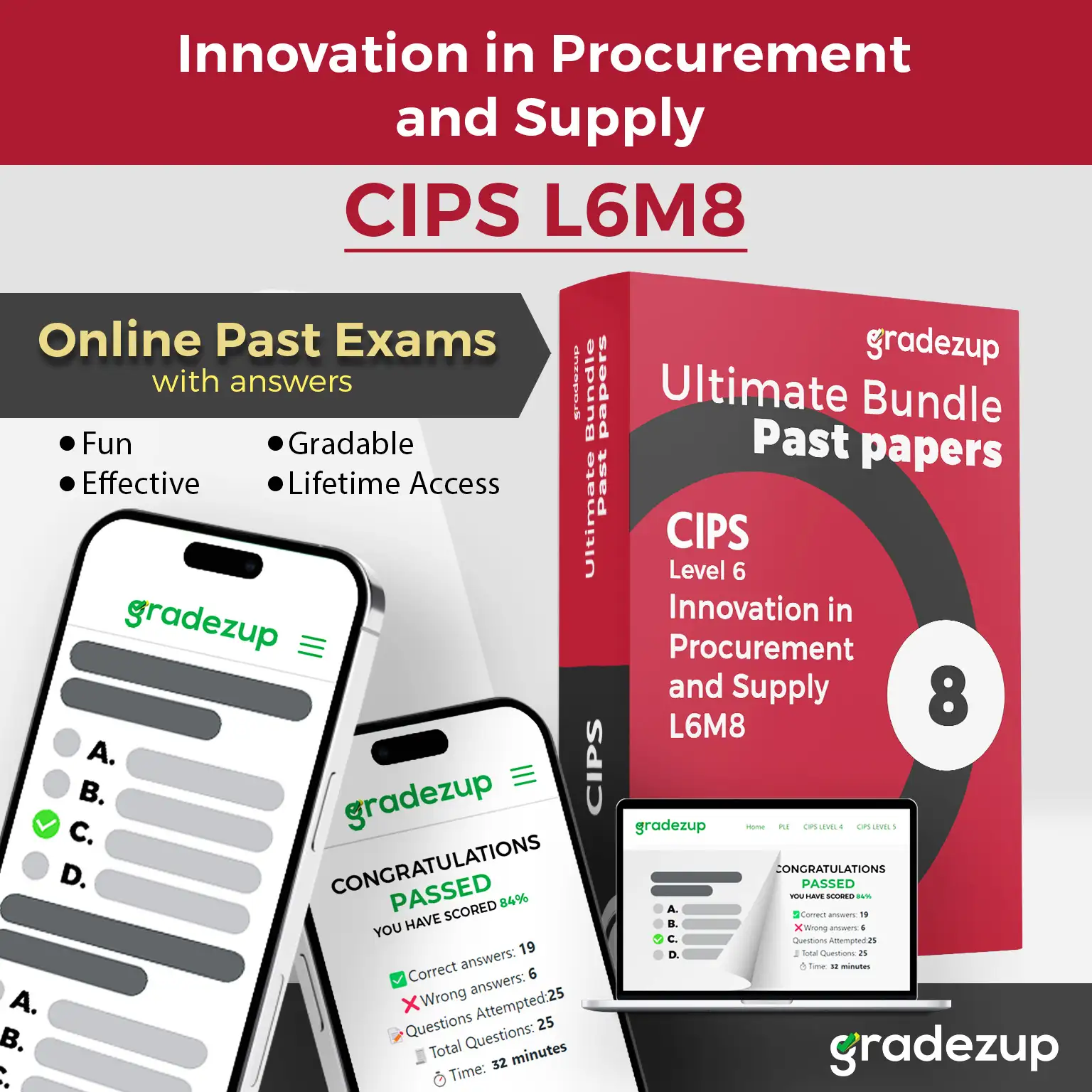
CIPS for level 6
Original price was: $ 9.99.$ 4.99Current price is: $ 4.99.
What you will get
- Detailed explanations for every answer
- Instant feedback and scoring
- Practice on any device, anytime
- Full access with your Gradezup plan
📲 Join our free WhatsApp channel: an exam question every day.
This course includes
- 📝15 timed practice papers
- ✓375+ exam-standard questions
- ⚡Instant auto-marking & worked answers
- ⏸Pause & resume any paper
- 📊Track your scores over time
- 📱Works on any device
Already purchased but can’t access your course? Restore access
Your papers live in your account, so the first step is to sign in — using the same email address you paid with. If you checked out as a guest and have never made an account, create one on that address and everything you bought appears automatically.
Community polls
Vote to see how other learners answered.
Loading polls...
What the L6M8 syllabus covers
The official L6M8 syllabus has 3 learning outcomes. Every Gradezup L6M8 paper is written to these outcomes and their assessment criteria.
1.0 Understand techniques for supplier development
-
1.1
Assess cross-functional working to achieve improvements in the supply chain
Key topics (3)
- Cross-functional involvement in the development of specifications and requirements
- Simultaneous (concurrent) engineering
- Product and process design
-
1.2
Evaluate techniques to promote the development of innovation in procurement and supply
Key topics (7)
- Collaboration with suppliers and customers to promote improvements in innovation
- Early supplier involvement
- The role of innovation councils
- Supplier forums and associations
- The use of technology transfer
- The use of data analytics to assist planning, forecasting, control and decision-making
- The use of integration tools in systems technology
-
1.3
Contrast the developments in technology that can be applied to promote improvements in supply chains
Key topics (8)
- Forms of e-procurement
- E-catalogues
- E-sourcing
- E-auctions
- P2P (purchase to pay) systems
- Data integrity and integration between organisations in a supply chain
- XML (extensible markup language) and the use of application programming interfaces (APIs) and other integration tools
- Developments in technology such as: Cloud computing; Open-source software; Mobile telecommunications; Remote working; Convergence of technology platforms
-
1.4
Evaluate the use of relationship assessment for supplier development
Key topics (3)
- The use of joint performance appraisal systems
- The use of relationship assessment methodologies
- The use of balanced scorecards
2.0 Understand methods to achieve procurement and supply improvement and innovation
-
2.1
Evaluate where technology can be used to improve procurement and supply
Key topics (1)
- Areas such as: Expenditure control; Data analytics and capture; Systems integration with suppliers and supply chains; Organisational systems integration to improve senior management and stakeholder knowledge and information flow; Artificial Intelligence (AI) and predictive analysis
-
2.2
Evaluate tools and techniques which are available to improve procurement and supply
Key topics (2)
- Tools such as: Total quality approaches; Statistical analysis; Just-in-Time (JIT); Lean thinking and lean supply; Business Process Re-engineering (BPR); ERP; Databases
- The use of business continuity planning to mitigate supply chain interruption
-
2.3
Assess methods to incentivise improvement and innovation
Key topics (5)
- Bidding
- Selection
- Contract award
- Contract management
- Setting examples and maintaining standards
3.0 Understand the environmental factors which affect supply chain improvement and innovation
-
3.1
Assess approaches to environmentally sensitive design
Key topics (5)
- Lifecycle analysis
- Design for disassembly
- Use environmentally friendly materials
- ISO 14001 – Environmental Standards
- ISO 20400 – Sustainable Procurement Standard
-
3.2
Assess the impact of green procurement on improvement and innovation
Key topics (2)
- Impact on strategic policy and planning
- Sustainable procurement: Low carbon; Low waste; Water efficient; Respect biodiversity; International targets and agreements
From the official CIPS L6M8 syllabus.
Peer Review Dashboard NEW
Review other students' quiz submissions and track your own submission status across all quizzes.
Submissions Available for Review
Select a submission from any quiz to claim and review. You cannot review your own submissions.
Loading available submissions...
Please sign in to view and create your polls.
Community polls
Loading polls...
Frequently asked questions
What is CIPS L6M8?
CIPS L6M8 Innovation in Procurement and Supply is an elective module of the CIPS Level 6 Professional Diploma in Procurement, worth 6 credits. It is assessed by a 1.5-hour objective-response (multiple-choice) exam. It teaches you to evaluate techniques for supplier development and innovation in procurement and supply and appraise the environmental factors which should be considered when applying such methods.
Is L6M8 a core or elective module?
L6M8 is an elective module of the CIPS Level 6 Professional Diploma in Procurement, worth 6 credits.
What type of exam is L6M8?
L6M8 is assessed by a 1.5-hour objective-response exam made up of multiple-choice questions.
What is the L6M8 pass mark?
You need 70% to pass an objective-response exam.
How many L6M8 practice papers are there?
Gradezup has 15 timed L6M8 practice papers with 375+ questions, written to the official syllabus, each marked the moment you submit with an explanation for every answer. At least one paper is free to try, no payment needed.
Are these the official CIPS L6M8 past papers?
No. CIPS does not publish its live exam papers. Gradezup papers are original exam-style practice papers written to the official L6M8 syllabus and modelled on the style and difficulty of the real exam.
What do I get when I enrol?
15 timed practice papers, 375+ exam-standard questions in total, each one auto-marked the moment you submit, with a worked answer and the reasoning behind every option. Your scores are tracked across attempts so you can see what is improving.
Do I have to work through the papers in order?
No. Every paper in CIPS L6M8 Innovation in Procurement and Supply unlocks as soon as you enrol, so you can start wherever you are weakest and retake any paper as often as you like.
How long do I have access?
Access does not expire. Once you enrol the course stays on your account, including any papers added to it later.
Can I pause a paper and finish it later?
Yes. Any paper can be paused mid-attempt and resumed from the same question, which makes short practice sessions workable.
What device do I need?
Any device with a browser — desktop, tablet or phone. There is nothing to install and nothing to download.
How close are these to the real CIPS for level 6 exam?
Every paper is written against the current CIPS for level 6 syllabus and mirrors the structure, question style and difficulty of the real exam, so practising here rehearses the exam itself rather than the topic in the abstract.
What is peer review?
Written answers cannot be auto-marked, so this course lets you submit yours for review by other learners working the same papers — and review theirs. Marking someone else against the rubric is usually the fastest way to see what an examiner is looking for.
Questions from students
No questions yet — ask the first one.
You must be logged in to ask a question.
Related products
-
CIPS level 4
CIPS L4M4 Ethical and Responsible Sourcing
Original price was: $ 9.99.$ 4.99Current price is: $ 4.99. -
CIPS for level 6
CIPS L6M7 Commercial Data Management
Original price was: $ 9.99.$ 4.99Current price is: $ 4.99. -
CIPS level 4
CIPS L4M7 Whole-Life Asset Management
Original price was: $ 9.99.$ 4.99Current price is: $ 4.99. -
CIPS for level 6
CIPS L6M2 Global Commercial Strategy
Original price was: $ 9.99.$ 4.99Current price is: $ 4.99.


Reviews
There are no reviews yet.