Original price was: $ 9.99.$ 4.99Current price is: $ 4.99.
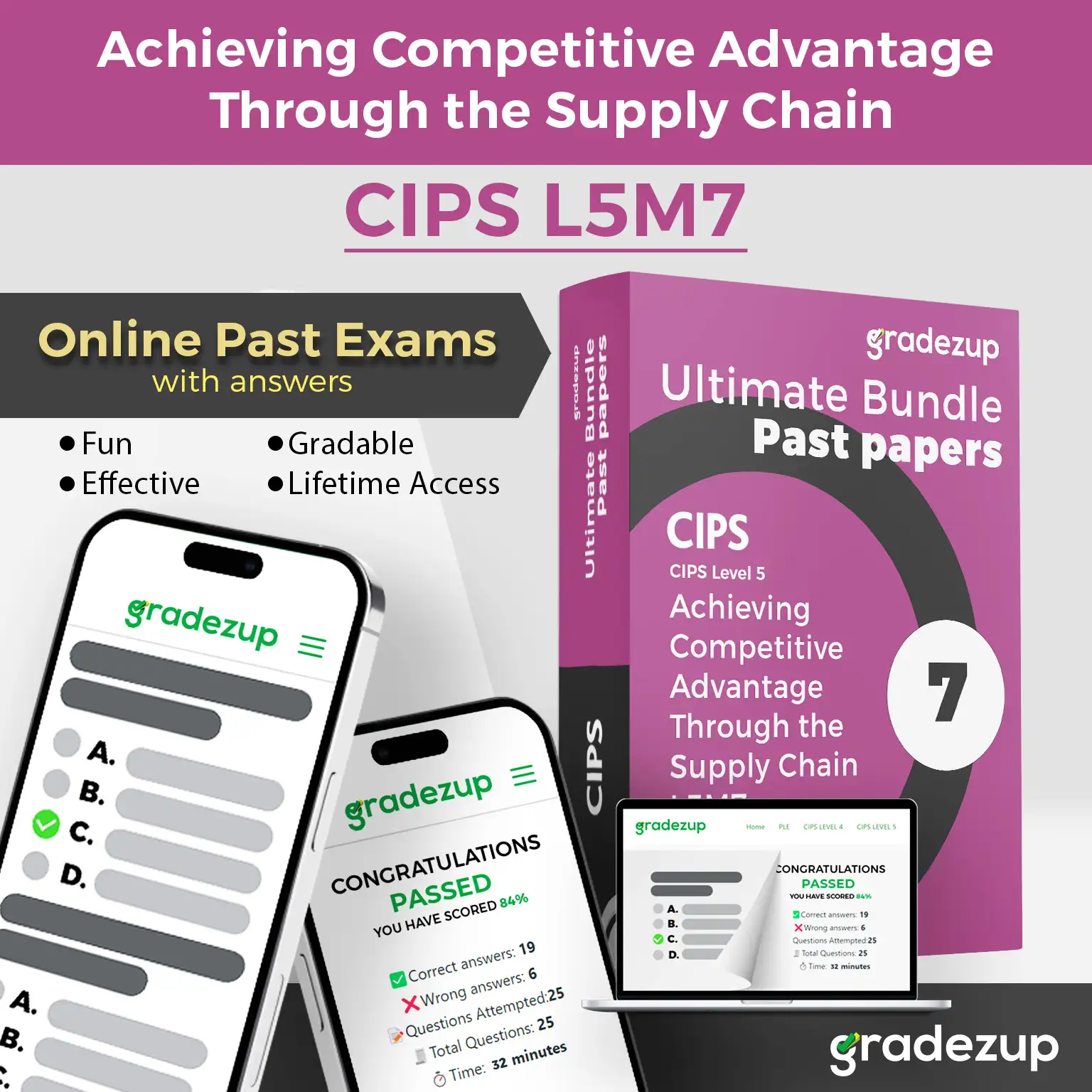
Prepare for the CIPS Diploma in Procurement and Supply with ease. Failing and retaking exams can be costly, but fret no more. Our meticulously crafted set of questions is designed to assist you in acing your exam on your first attempt. This bundle includes  lifetime access to newly uploaded papers.
Lifetime access
📲 Join our free WhatsApp channel: an exam question every day.
This course includes
- 📝19 timed practice papers
- ✓445+ exam-standard questions
- ⚡Instant auto-marking & worked answers
- ⏸Pause & resume any paper
- 📊Track your scores over time
- 📱Works on any device
Already purchased but can’t access your course? Restore access
Your papers live in your account, so the first step is to sign in — using the same email address you paid with. If you checked out as a guest and have never made an account, create one on that address and everything you bought appears automatically.
Community polls
Vote to see how other learners answered.
Loading polls...
What the L5M7 syllabus covers
The official L5M7 syllabus has 3 learning outcomes. Every Gradezup L5M7 paper is written to these outcomes and their assessment criteria.
1.0 Understand the dynamics of supply chains
-
1.1
Compare supply chains, supply network and supply chain management
Key topics (2)
- Defining supply chains, supply networks and supply chain management
- The use of supplier tiering and network sourcing
-
1.2
Analyse the added value that effective supply chain management can deliver for the organisation
Key topics (5)
- Improving quality
- Reducing prices and total costs
- Reducing time to market and achieving deliveries to required timescales
- Creating innovation
- Reducing risk and supply chain vulnerability
-
1.3
Analyse the relationship between organisational infrastructure and process management in supply chain management
Key topics (5)
- Theoretical perspectives on added value
- Aspects of organisational infrastructure: culture, organisational structure, and systems
- Process management: the sourcing process in procurement and managing stages of the process
- Process mapping techniques
- Value chain analysis
-
1.4
Compare approaches to improving supply chains
Key topics (5)
- The spectrum of relationships in a supply chain
- The collaborative model of supply chain management: partnering and strategic relationship management
- The competitive model of supply chain management
- The outsourcing of work or services
- Off shoring, global procurement and low-cost country sourcing
2.0 Understand improvement methodologies that can be used in supply chains
-
2.1
Compare approaches to total quality management for supply chain improvement
Key topics (4)
- Defining quality and total quality management
- Approaches to quality: quality inspection, quality assurance and total quality
- Quality vs. risk
- The importance of relationships in quality management
-
2.2
Analyse the use of statistical methods to achieve supply chain improvement
Key topics (7)
- Collating data for performance measurement
- Developing key performance indicators (KPIs) on aspects of supply performance
- Analysing data and an introduction to statistics
- The use of the normal distribution
- Developing statistical process control
- The 6 sigma improvement methodology
- Creating continuous improvement
-
2.3
Critically appraise processes that can be used for supply chain improvement
Key topics (5)
- Just-in-time (JIT) supply processes
- The application of JIT in the service sector
- The development of lean thinking and lean supply
- Lean thinking compared with agile
- The 5S methodology
-
2.4
Examine how business process re-engineering (BPR) and benchmarking can be used for supply chain improvement
Key topics (3)
- The development of business process re-engineering (BPR)
- BPR in contrast to total quality
- The use of benchmarking in supply chains
3.0 Understand measures required to achieve competitive advantage in supply chains
-
3.1
Evaluate sources of competitive advantage
Key topics (2)
- Competitive advantage based on lowest cost of supply
- Competitive advantage achieved through sources of differential advantage such as innovation, range of products, brand image and customer care
-
3.2
Analyse pricing arrangements that can be used to achieve competitive advantage in the supply chain
Key topics (3)
- The use of fixed pricing, variable pricing, and cost plus arrangements
- The use of open book costing and cost transparency
- The use of incentivisation in pricing and gain share (risk/reward) mechanisms
-
3.3
Analyse cost reduction activities for a supply chain to achieve competitive advantage
Key topics (5)
- Supplier rationalisation and aggregation of requirements
- The risks and benefits associated with single sourcing arrangements
- Negotiating reductions in prices and costs
- Collaborative and competitive models of supply
- Value analysis and value engineering
-
3.4
Assess methods to promote greater collaboration in supply chains to support the achievement of competitive advantage
Key topics (4)
- Strategic vs. operational suppliers
- Creating partnership sourcing arrangements
- Building trust with suppliers
- The relationship life cycle
From the official CIPS L5M7 syllabus.
Peer Review Dashboard NEW
Review other students' quiz submissions and track your own submission status across all quizzes.
Submissions Available for Review
Select a submission from any quiz to claim and review. You cannot review your own submissions.
Community polls
Loading polls...
Frequently asked questions
What is CIPS L5M7?
CIPS L5M7 Achieving Competitive Advantage Through the Supply Chain is an elective module of the CIPS Level 5 Advanced Diploma in Procurement and Supply, worth 6 credits. It is assessed by a 1.5-hour objective-response (multiple-choice) exam. It teaches you to assess a range of processes that support the achievement of competitive advantage and improvements in organisational performance through its supply chain.
Is L5M7 a core or elective module?
L5M7 is an elective module of the CIPS Level 5 Advanced Diploma in Procurement and Supply, worth 6 credits.
What type of exam is L5M7?
L5M7 is assessed by a 1.5-hour objective-response exam made up of multiple-choice questions.
What is the L5M7 pass mark?
You need 70% to pass an objective-response exam.
How many L5M7 practice papers are there?
Gradezup has 19 timed L5M7 practice papers with 445+ questions, written to the official syllabus, each marked the moment you submit with an explanation for every answer. At least one paper is free to try, no payment needed.
Are these the official CIPS L5M7 past papers?
No. CIPS does not publish its live exam papers. Gradezup papers are original exam-style practice papers written to the official L5M7 syllabus and modelled on the style and difficulty of the real exam.
What do I get when I enrol?
19 timed practice papers, 445+ exam-standard questions in total, each one auto-marked the moment you submit, with a worked answer and the reasoning behind every option. Your scores are tracked across attempts so you can see what is improving.
Do I have to work through the papers in order?
No. Every paper in CIPS L5M7 Achieving Competitive Advantage Through the Supply Chain unlocks as soon as you enrol, so you can start wherever you are weakest and retake any paper as often as you like.
How long do I have access?
Access does not expire. Once you enrol the course stays on your account, including any papers added to it later.
Can I pause a paper and finish it later?
Yes. Any paper can be paused mid-attempt and resumed from the same question, which makes short practice sessions workable.
What device do I need?
Any device with a browser — desktop, tablet or phone. There is nothing to install and nothing to download.
How close are these to the real CIPS level 5 exam?
Every paper is written against the current CIPS level 5 syllabus and mirrors the structure, question style and difficulty of the real exam, so practising here rehearses the exam itself rather than the topic in the abstract.
What is peer review?
Written answers cannot be auto-marked, so this course lets you submit yours for review by other learners working the same papers — and review theirs. Marking someone else against the rubric is usually the fastest way to see what an examiner is looking for.
Questions from students
No questions yet — ask the first one.
You must be logged in to ask a question.


Reviews
There are no reviews yet.