CIPS Level 6 Professional Diploma in Procurement · Core module

CIPS L6M3 Global Strategic Supply Chain Management

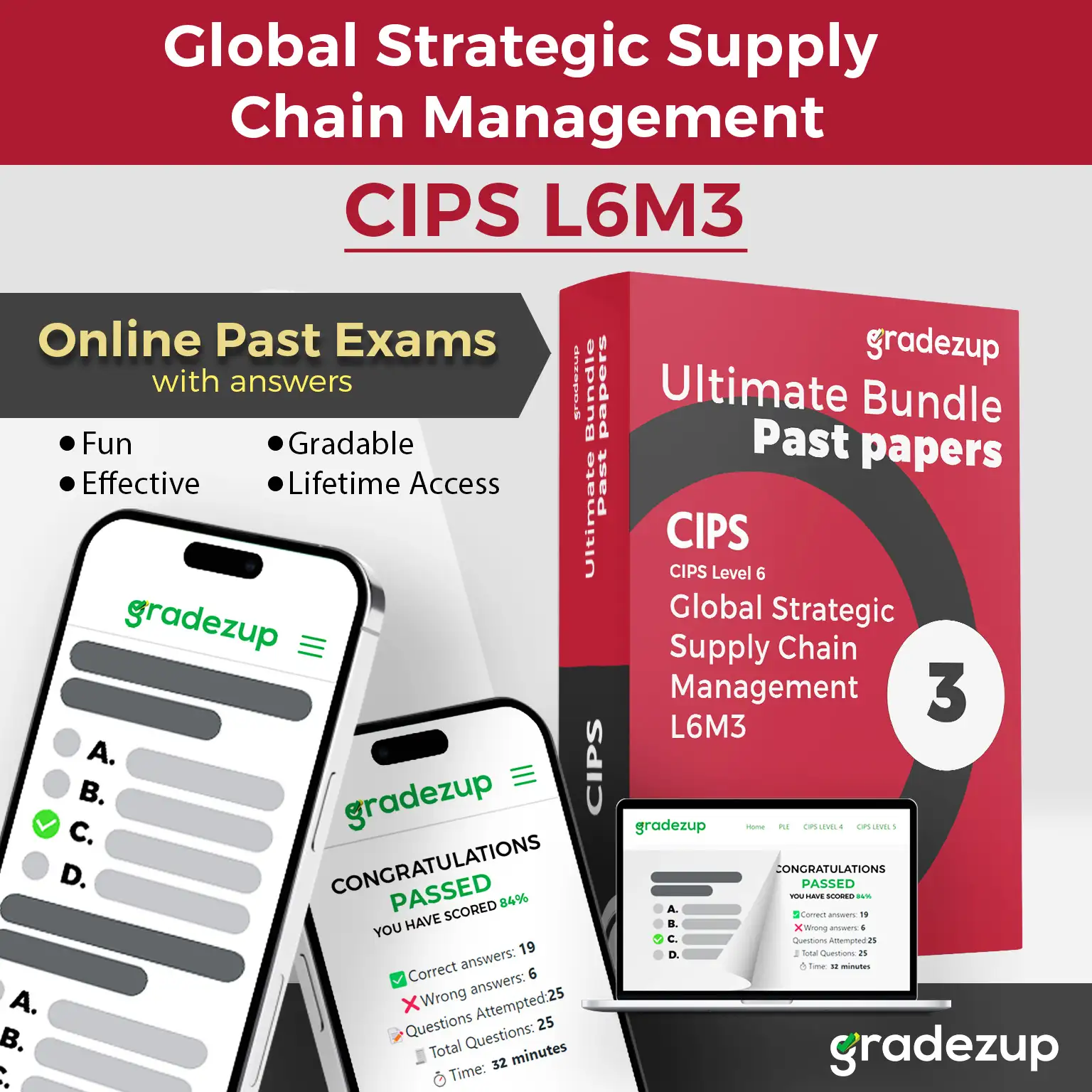
CIPS L6M3 Global Strategic Supply Chain Management is a core module of the CIPS Level 6 Professional Diploma in Procurement, worth 12 credits. It is assessed by a 3-hour constructed-response (written) exam. It teaches you to evaluate the influence of strategic supply chain management and assess the methods available to measure, improve, and optimise supply chain performance.

Practice papers
20
Questions
80+
Exam length
3 h
Credits
12
Sale!

CIPS for level 6 · 20 practice papers · 80+ questions

Original price was: $ 9.99.Current price is: $ 4.99.

What you will get

  • Detailed explanations for every answer
  • Model answers to compare against
  • Practice on any device, anytime
  • Full access with your Gradezup plan

📲 Join our free WhatsApp channel: an exam question every day.

FreeStart practice

This course includes

  • 📝20 timed practice papers
  • ✓80+ exam-standard questions
  • ⚡Instant auto-marking & worked answers
  • ⏸Pause & resume any paper
  • 📊Track your scores over time
  • 📱Works on any device
Already purchased but can’t access your course? Restore access

Your papers live in your account, so the first step is to sign in — using the same email address you paid with. If you checked out as a guest and have never made an account, create one on that address and everything you bought appears automatically.

Sign in or create your account

Community polls

Vote to see how other learners answered.

Loading polls...

What the L6M3 syllabus covers

The official L6M3 syllabus has 4 learning outcomes. Every Gradezup L6M3 paper is written to these outcomes and their assessment criteria.

1.0 Understand how strategic supply chain management can support corporate business strategy

  • 1.1
    Assess the relationship between functional, business and corporate levels of strategy
    Key topics (4)
    • The relationship between the supply chain, business and corporate levels of strategy
    • The impact of supply chain management on business and corporate performance
    • The impact on the profitability of the supply chain
    • Supply chain risks and their impact on business and corporate performance
  • 1.2
    Evaluate the contribution of strategic supply chain management
    Key topics (4)
    • Creating sources of competitive advantage: cost, improved quality, time to market, product and service differentiation
    • Enterprise profit optimisation
    • The use of outsourcing to create value and achieve competitive advantage
    • Strategies to support supply chain management: offshoring, outsourcing, inshoring, insourcing
  • 1.3
    Evaluate the impact of market change on strategic supply chain management
    Key topics (5)
    • STEEPLED (social, technological, economic, environmental, political, legal, ethical and demographic) factors and their impact and risks on supply chains
    • Distinguishing between disruptive and incremental change
    • Changing markets and market volatility
    • The impact of globalisation on supply chains
    • The impact of environmental, social and governance (ESG) factors on strategic supply chain management
  • 1.4
    Evaluate approaches to developing and implementing strategic relationship management
    Key topics (3)
    • The purpose of strategic alignment
    • Customer, supplier, and stakeholder relationship management
    • Methodologies for the implementation of strategic relationship management

2.0 Understand and apply supply chain design tools and techniques

  • 2.1
    Evaluate approaches to segmentation
    Key topics (3)
    • Approaches to segmenting customers, suppliers and stakeholders
    • Managing the product and service mix
    • Creating strategies for the different tiers of a supply chain
  • 2.2
    Assess approaches to developing networked supply chains
    Key topics (5)
    • Supply chain flows and the use of supply chain and the value stream
    • Tiering in supply chains and the use of network sourcing
    • Identifying value-added activities and the value chain in supply chain networks
    • Network optimisation modelling
    • The circular economy and the use of reverse logistics in supply chain networks
  • 2.3
    Assess the role of distribution systems
    Key topics (8)
    • Channel design
    • The impact of e-commerce on distribution networks
    • Logistics flow path design
    • Physical network configuration
    • Challenges in transportation management
    • Locations of distribution centres
    • Positioning in local, regional and global chains
    • The impact of environmental, social and governance (ESG) considerations on distribution systems
  • 2.4
    Evaluate Lean and agile supply chains
    Key topics (5)
    • The benefits and challenges of lean and agile supply chains: security, sustainability, and economies of scale (EOS)
    • Implementing Lean supply and Lean thinking
    • The impact of promotions and causal events on demand
    • Improving demand planning accuracy and the use of statistical forecasting
    • Supply chain visibility (SCV)

3.0 Understand and apply techniques to achieve effective strategic supply chain management

  • 3.1
    Evaluate approaches to developing and implementing supply chain collaboration
    Key topics (4)
    • Supply chain evolution from transactional information sharing to collaborative approaches in supply chain management
    • Creating collaborative relationships with customers, suppliers and other stakeholders
    • The use of shared services in supply chains
    • Data integration in supply chains
  • 3.2
    Evaluate approaches to managing change within supply chains when working with stakeholders
    Key topics (4)
    • Communicating plans with customers, suppliers, senior management and other organisational functions
    • Evaluating and implementing resources for strategic supply chain management
    • The role of the change agent
    • Evaluating the acceptance of strategic change
  • 3.3
    Analyse approaches to measuring supply chain performance
    Key topics (4)
    • Measures of supply chain performance: price, safety, quality, costs, and environmental, social and governance (ESG)
    • Measuring processes and the use of key performance indicators (KPIs) in supply chain management
    • Measuring supply chain, organisational, functional, team and individual performance
    • Analyse mechanisms for gathering feedback on supply chain performance
  • 3.4
    Analyse how the development of knowledge, skills and behaviours can help achieve effective strategic supply chain management
    Key topics (4)
    • The concept of knowledge management within the organisation and with suppliers
    • The importance of developing procurement and supply chain competencies
    • Training and development to improve knowledge, skills and behaviours within the organisation and stakeholders across the supply chain
    • Approaches to measurement, analysis, improvement and control to develop knowledge, skills and behaviours

4.0 Understand and apply methods to measure, improve and optimise supply chain performance

  • 4.1
    Assess methods to improve and optimise supply chain performance
    Key topics (7)
    • The number of operating facilities and their locations
    • The number of suppliers
    • Assess the flow of items through the supply chain network
    • Network Optimisation Models (NOM)
    • Risk identification and management
    • Collaborative planning, forecasting and replenishment (CPFR)
    • Business process re-engineering (BPR)
  • 4.2
    Assess tools and techniques to help the organisation achieve strategic fit within the supply chain
    Key topics (5)
    • Analysing and managing supply chain uncertainties: demand, supply, disruption and delay
    • Define desired cost and service requirements
    • Assess the supply chain capabilities, strengths and weaknesses
    • Achieving strategic fit through supply chain design and competitive strategy
    • Trade-offs between efficiency and responsiveness, zone of strategic fit and cost responsiveness frontier
  • 4.3
    Assess the challenges to achieving and maintaining strategic fit
    Key topics (5)
    • Increasing product variety and shrinking life cycles
    • Globalisation and increasing uncertainty
    • Fragmentation and increased complexity of the supply chain
    • Changing technology and the business environment
    • The effect of environmental, social and governance (ESG) considerations on strategic fit

From the official CIPS L6M3 syllabus.

Peer Review Dashboard NEW

Review other students' quiz submissions and track your own submission status across all quizzes.

Guest Access: You can review 1 submission and vote on 1 poll per month. Sign in for full access.

Submissions Available for Review

Select a submission from any quiz to claim and review. You cannot review your own submissions.

Loading available submissions...

Review Submission

Community polls

Loading polls...

Frequently asked questions

  • What is CIPS L6M3?

    CIPS L6M3 Global Strategic Supply Chain Management is a core module of the CIPS Level 6 Professional Diploma in Procurement, worth 12 credits. It is assessed by a 3-hour constructed-response (written) exam. It teaches you to evaluate the influence of strategic supply chain management and assess the methods available to measure, improve, and optimise supply chain performance.

  • Is L6M3 a core or elective module?

    L6M3 is a core module of the CIPS Level 6 Professional Diploma in Procurement, worth 12 credits.

  • What type of exam is L6M3?

    L6M3 is assessed by a 3-hour constructed-response exam, where you write extended answers to the questions set.

  • What is the L6M3 pass mark?

    Constructed-response exams are graded: 50% is a Pass, 60% a Merit and 75% a Distinction.

  • How many L6M3 practice papers are there?

    Gradezup has 20 timed L6M3 practice papers with 80+ questions, written to the official syllabus, with model answers to compare against. At least one paper is free to try, no payment needed.

  • Are these the official CIPS L6M3 past papers?

    No. CIPS does not publish its live exam papers. Gradezup papers are original exam-style practice papers written to the official L6M3 syllabus and modelled on the style and difficulty of the real exam.

  • What do I get when I enrol?

    20 timed practice papers, 80+ exam-standard questions in total, each one auto-marked the moment you submit, with a worked answer and the reasoning behind every option. Your scores are tracked across attempts so you can see what is improving.

  • Do I have to work through the papers in order?

    No. Every paper in CIPS L6M3 Global Strategic Supply Chain Management unlocks as soon as you enrol, so you can start wherever you are weakest and retake any paper as often as you like.

  • How long do I have access?

    Access does not expire. Once you enrol the course stays on your account, including any papers added to it later.

  • Can I pause a paper and finish it later?

    Yes. Any paper can be paused mid-attempt and resumed from the same question, which makes short practice sessions workable.

  • What device do I need?

    Any device with a browser — desktop, tablet or phone. There is nothing to install and nothing to download.

  • How close are these to the real CIPS for level 6 exam?

    Every paper is written against the current CIPS for level 6 syllabus and mirrors the structure, question style and difficulty of the real exam, so practising here rehearses the exam itself rather than the topic in the abstract.

  • What is peer review?

    Written answers cannot be auto-marked, so this course lets you submit yours for review by other learners working the same papers — and review theirs. Marking someone else against the rubric is usually the fastest way to see what an examiner is looking for.

Questions from students

No questions yet — ask the first one.

Reviews

There are no reviews yet.

Be the first to review “CIPS L6M3 Global Strategic Supply Chain Management”

Your email address will not be published. Required fields are marked *

Scroll to Top