
1 free to try · 1 of 10 unlocked — enrol to open the rest
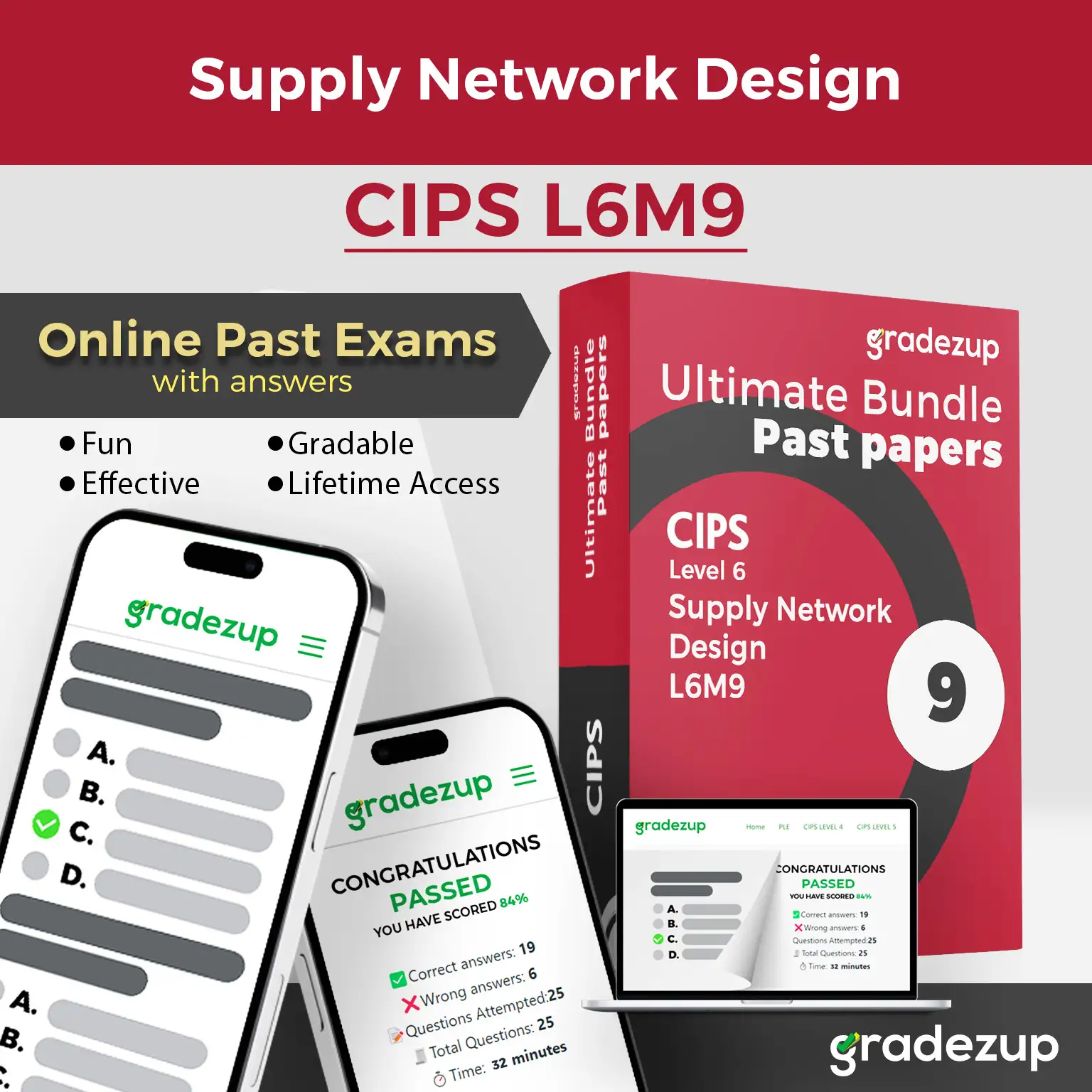
CIPS for level 6
Original price was: $ 9.99.$ 4.99Current price is: $ 4.99.
What you will get
- Detailed explanations for every answer
- Instant feedback and scoring
- Practice on any device, anytime
- Full access with your Gradezup plan
📲 Join our free WhatsApp channel: an exam question every day.
This course includes
- 📝10 timed practice papers
- ✓250+ exam-standard questions
- ⚡Instant auto-marking & worked answers
- ⏸Pause & resume any paper
- 📊Track your scores over time
- 📱Works on any device
Already purchased but can’t access your course? Restore access
Your papers live in your account, so the first step is to sign in — using the same email address you paid with. If you checked out as a guest and have never made an account, create one on that address and everything you bought appears automatically.
Community polls
Vote to see how other learners answered.
Loading polls...
What the L6M9 syllabus covers
The official L6M9 syllabus has 3 learning outcomes. Every Gradezup L6M9 paper is written to these outcomes and their assessment criteria.
1.0 Understand the strategic nature and influence of supply network design
-
1.1
Assess the meaning of supply network design and the influence that it has on the organisation
Key topics (6)
- What is supply network design
- Supply network terminology and structures
- Supply network vs. supply chain
- Where are operations located in the supply network – logistical impact
- What influence does capacity and resources have on the supply network
- Value adding and competitive advantage
-
1.2
Evaluate how a strategic supply chain network should be configured
Key topics (3)
- Influence of the Internet – 'disintermediation'
- The value net and four players - suppliers, customers, competitors and complementors
- Decisions such as: Make or buy; Insource or outsource; Vertical integration; Outsourcing and offshoring
-
1.3
Assess the influence of capacity on strategic supply chain design
Key topics (5)
- Optimum capacity
- Large vs. small capacity – advantages and disadvantages
- The timing of capacity change
- Capacity increments: Capacity leading and lagging strategies; Inventory 'smoothing'
- Break even analysis for capacity expansion
2.0 Understand operations strategy and its contribution to overall business success
-
2.1
Assess the meaning of operations strategy and the impact that it has on the organisation
Key topics (5)
- What is operations strategy
- How to identify if an organisation has an operations strategy
- Is the operations strategy relevant and aligned to the overall business strategy
- Does the operations strategy align with market requirements and available resources
- The contribution of operations strategy to competitive advantage and added value
-
2.2
Evaluate the key elements of an operations strategy
Key topics (1)
- Should include key elements such as: A clear vision and objectives; The 4 stages model of operations – internal neutrality, external neutrality, internally; Performance objectives – quality, speed, dependability, flexibility and cost; Reconcile strategic decisions to objectives; Capacity and resources vs. timescales and outputs
-
2.3
Assess the role of improvement in operations strategy
Key topics (5)
- Continuous improvement
- Drivers for effectiveness and efficiency
- Improving operations through trade-offs between performance objectives
- Trade-offs and the efficient frontier
- Improving operational effectiveness by overcoming trade-offs
3.0 Assess the strategic value of resource planning and control
-
3.1
Evaluate the concept of strategic resource planning and control
Key topics (2)
- What is resource planning and control
- Influences on resource planning such as: Translating customer need into operational delivery; Customer expectation and management; Forecasting, capacity, resources, priorities, scheduling, monitoring, control; Information and data gathering and management
-
3.2
Assess the key elements of a resource strategic planning and control system
Key topics (5)
- Core mechanics of the process such as: Loading; Prioritisation and sequencing; Scheduling; Monitoring and control
- Decision mechanism: Planning and control staff; Planning and control information system
- Customer interface
- Supply interface
- Other business functions
-
3.3
Contrast methods of monitoring and controlling the strategic operation
Key topics (2)
- Degree of difficulty in controlling operations
- Consider methods of control such as: Push and pull; Theory of constraints (TOC) and drum (bottleneck), buffer stock and rope; MRP and MRP II; Web-integrated and supply network ERP
From the official CIPS L6M9 syllabus.
Peer Review Dashboard NEW
Review other students' quiz submissions and track your own submission status across all quizzes.
Submissions Available for Review
Select a submission from any quiz to claim and review. You cannot review your own submissions.
Loading available submissions...
Please sign in to view and create your polls.
Community polls
Loading polls...
Frequently asked questions
What is CIPS L6M9?
CIPS L6M9 Supply Network Design is an elective module of the CIPS Level 6 Professional Diploma in Procurement, worth 6 credits. It is assessed by a 1.5-hour objective-response (multiple-choice) exam. It teaches you to evaluate the strategic nature, influence, and contribution of supply network design and operations to the overall business strategy and assess the strategic value of resource planning and control.
Is L6M9 a core or elective module?
L6M9 is an elective module of the CIPS Level 6 Professional Diploma in Procurement, worth 6 credits.
What type of exam is L6M9?
L6M9 is assessed by a 1.5-hour objective-response exam made up of multiple-choice questions.
What is the L6M9 pass mark?
You need 70% to pass an objective-response exam.
How many L6M9 practice papers are there?
Gradezup has 10 timed L6M9 practice papers with 250+ questions, written to the official syllabus, each marked the moment you submit with an explanation for every answer. At least one paper is free to try, no payment needed.
Are these the official CIPS L6M9 past papers?
No. CIPS does not publish its live exam papers. Gradezup papers are original exam-style practice papers written to the official L6M9 syllabus and modelled on the style and difficulty of the real exam.
What do I get when I enrol?
10 timed practice papers, 250+ exam-standard questions in total, each one auto-marked the moment you submit, with a worked answer and the reasoning behind every option. Your scores are tracked across attempts so you can see what is improving.
Do I have to work through the papers in order?
No. Every paper in CIPS L6M9 Supply Network Design unlocks as soon as you enrol, so you can start wherever you are weakest and retake any paper as often as you like.
How long do I have access?
Access does not expire. Once you enrol the course stays on your account, including any papers added to it later.
Can I pause a paper and finish it later?
Yes. Any paper can be paused mid-attempt and resumed from the same question, which makes short practice sessions workable.
What device do I need?
Any device with a browser — desktop, tablet or phone. There is nothing to install and nothing to download.
How close are these to the real CIPS for level 6 exam?
Every paper is written against the current CIPS for level 6 syllabus and mirrors the structure, question style and difficulty of the real exam, so practising here rehearses the exam itself rather than the topic in the abstract.
What is peer review?
Written answers cannot be auto-marked, so this course lets you submit yours for review by other learners working the same papers — and review theirs. Marking someone else against the rubric is usually the fastest way to see what an examiner is looking for.
Questions from students
No questions yet — ask the first one.
You must be logged in to ask a question.
Related products
-
CIPS level 5
CIPS L5M15 Advanced Negotiation
Original price was: $ 9.99.$ 4.99Current price is: $ 4.99. -
CIPS level 5
CIPS L5M8 Project and Change Management
Original price was: $ 9.99.$ 4.99Current price is: $ 4.99. -
CIPS level 4
CIPS L4M4 Ethical and Responsible Sourcing
Original price was: $ 9.99.$ 4.99Current price is: $ 4.99. -
CIPS for level 6
CIPS L6M7 Commercial Data Management
Original price was: $ 9.99.$ 4.99Current price is: $ 4.99.



Reviews
There are no reviews yet.