1 free to try · 1 of 10 unlocked — enrol to open the rest
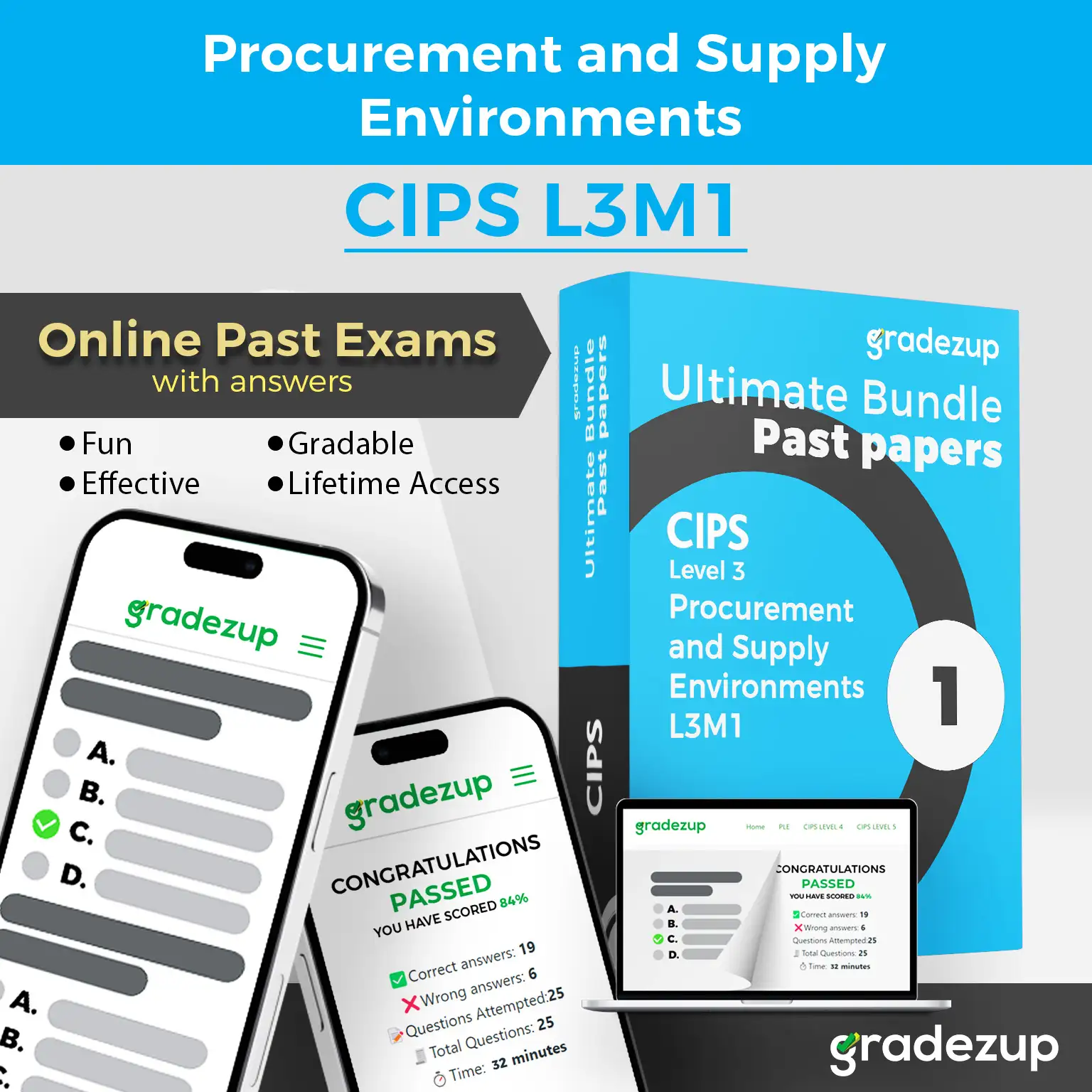
CIPS level 3
Original price was: $ 9.99.$ 4.99Current price is: $ 4.99.
What you will get
- Detailed explanations for every answer
- Instant feedback and scoring
- Practice on any device, anytime
- Full access with your Gradezup plan
📲 Join our free WhatsApp channel: an exam question every day.
This course includes
- 📝10 timed practice papers
- ✓250+ exam-standard questions
- ⚡Instant auto-marking & worked answers
- ⏸Pause & resume any paper
- 📊Track your scores over time
- 📱Works on any device
Already purchased but can’t access your course? Restore access
Your papers live in your account, so the first step is to sign in — using the same email address you paid with. If you checked out as a guest and have never made an account, create one on that address and everything you bought appears automatically.
Community polls
Vote to see how other learners answered.
Loading polls...
What the L3M1 syllabus covers
The official L3M1 syllabus has 4 learning outcomes. Every Gradezup L3M1 paper is written to these outcomes and their assessment criteria.
1.0 Know the different sectors of procurement and supply
-
1.1
Define the different types and functions of the private sector
Key topics (3)
- Definitions and different types of private sector organisations – sole traders, partnerships, registered companies, incorporated and unincorporated companies, SME, multinational corporations
- The size and scope of the private sector in different economies
- Functions of private sector organisations such as profit, growth, market share, share price, other financial measures, corporate and social responsibility
-
1.2
Describe the role and scope of procurement and supply in the private sector
Key topics (4)
- Sole trade, partnerships, registered companies, incorporated and unincorporated companies
- Small and medium sized organisations (SMEs)
- Multinational organisations
- The roles of procurement and supply in the private sector
-
1.3
Describe the role and scope of procurement and supply in the public sector
Key topics (8)
- Defining the public sector
- Central and local government
- The functions of public sector organisations
- The roles of procurement and supply in the public sector
- Commissioning and procurement
- Achieving budget savings and other sources of added value
- Providing access to services
- Regulating organisations and individuals
-
1.4
Describe the role and scope of procurement and supply in the not-for-profit and third sector
Key topics (3)
- Defining the not-for-profit and third sector
- Public accountability for the not-for-profit and third sector
- Define the role of procurement and supply in the not-for-profit and third sector
2.0 Understand types of pricing arrangements in commercial agreements
-
2.1
Explain how pricing arrangements are used in commercial agreements to ensure effective price and cost management
Key topics (7)
- Pricing schedules
- Fixed pricing arrangements
- Cost plus and cost reimbursable pricing arrangements
- Indexation and price adjustment formulae
- Incentivised gain share pricing
- Payment terms
- The use of open book costing and adjustments
3.0 Know the external environment and its impact on procurement and supply
-
3.1
Identify the impact of the external environment on procurement and supply
Key topics (7)
- The use of environmental scanning
- The use of PEST (political, economic, social and technological) criteria or STEEPLED (social, technological, economic, environmental, political, legislation, ethical and demographic) criteria that impacts on organisations' external environment
- The five forces model
- Competitive market forces
- Demand and supply
- Market factors
- Product life cycles
-
3.2
Describe how the implications of economic criteria impact on procurement and supply
Key topics (2)
- Macro-economic criteria such as interest rates, inflation, exchange rates, level of economic activity (GDP/GNP) that impacts on organisations
- Micro-economic criteria such as demand and supply that impacts on organisations
-
3.3
Describe how the implications of political and legislative criteria that impact on procurement and supply
Key topics (2)
- Political criteria such as stability and instability that impacts on organisations, different economic sectors and on countries
- Legislation that impacts on organisations such as on standards, health and safety, environmental standards and employment law
-
3.4
Describe how the implications of environmental and ethical criteria impact on procurement and supply
Key topics (2)
- Environmental criteria such as natural risks, waste emissions, pollution and energy efficiency that impact on organisations
- Ethical and social criteria such as ethical codes, employment rights, community benefits, working conditions and standards that impact on organisations
-
3.5
Describe how the implications of social criteria impact on procurement and supply
Key topics (2)
- Changing societal preferences, tastes and fashions, demographics, labour and fair-trade standards and how these can impact on organisations
- Corporate social responsibility
4.0 Understand procedures that regulate procurement and supply
-
4.1
Describe the types of documentation used in procurement and supply
Key topics (5)
- Requisitions
- Orders
- Delivery notes
- Invoices
- Other documents typically used in procurement and supply
-
4.2
Explain how documented policies and procedures are used within procurement and supply
Key topics (7)
- The responsibilities for procurement
- Regulations relating to competition
- Levels of delegated authority
- Responsibilities for the stages of the sourcing process
- Responsibilities for ensuring invoice clearance and payment
- Responsibilities for ensuring that requisitions, orders and invoices are clear and correct and clarify requirements for stakeholders
- Corporate governance
From the official CIPS L3M1 syllabus.
Peer Review Dashboard NEW
Review other students' quiz submissions and track your own submission status across all quizzes.
Submissions Available for Review
Select a submission from any quiz to claim and review. You cannot review your own submissions.
Loading available submissions...
Please sign in to view and create your polls.
Community polls
Loading polls...
Frequently asked questions
What is CIPS L3M1?
CIPS L3M1 Procurement and Supply Environments is a core module of the CIPS Level 3 Advanced Certificate in Procurement and Supply Operations, worth 6 credits. It is assessed by a 2-hour objective-response (multiple-choice) exam. It teaches you to identify the range of environments in which procurement and supply is expected to operate and the external factors that can impact on overall success.
Is L3M1 a core or elective module?
L3M1 is a core module of the CIPS Level 3 Advanced Certificate in Procurement and Supply Operations, worth 6 credits.
What type of exam is L3M1?
L3M1 is assessed by a 2-hour objective-response exam made up of multiple-choice questions.
What is the L3M1 pass mark?
You need 70% to pass an objective-response exam.
How many L3M1 practice papers are there?
Gradezup has 10 timed L3M1 practice papers with 250+ questions, written to the official syllabus, each marked the moment you submit with an explanation for every answer. At least one paper is free to try, no payment needed.
Are these the official CIPS L3M1 past papers?
No. CIPS does not publish its live exam papers. Gradezup papers are original exam-style practice papers written to the official L3M1 syllabus and modelled on the style and difficulty of the real exam.
What do I get when I enrol?
10 timed practice papers, 250+ exam-standard questions in total, each one auto-marked the moment you submit, with a worked answer and the reasoning behind every option. Your scores are tracked across attempts so you can see what is improving.
Do I have to work through the papers in order?
No. Every paper in CIPS L3M1 Procurement and Supply Environments unlocks as soon as you enrol, so you can start wherever you are weakest and retake any paper as often as you like.
How long do I have access?
Access does not expire. Once you enrol the course stays on your account, including any papers added to it later.
Can I pause a paper and finish it later?
Yes. Any paper can be paused mid-attempt and resumed from the same question, which makes short practice sessions workable.
What device do I need?
Any device with a browser — desktop, tablet or phone. There is nothing to install and nothing to download.
How close are these to the real CIPS level 3 exam?
Every paper is written against the current CIPS level 3 syllabus and mirrors the structure, question style and difficulty of the real exam, so practising here rehearses the exam itself rather than the topic in the abstract.
What is peer review?
Written answers cannot be auto-marked, so this course lets you submit yours for review by other learners working the same papers — and review theirs. Marking someone else against the rubric is usually the fastest way to see what an examiner is looking for.
Questions from students
No questions yet — ask the first one.
You must be logged in to ask a question.
Related products
-
CIPS level 4
CIPS L4M5 Commercial Negotiation
Original price was: $ 9.99.$ 4.99Current price is: $ 4.99. -
CIPS level 5
CIPS L5M4 Advanced Contract and Financial Management
Original price was: $ 9.99.$ 4.99Current price is: $ 4.99. -
CIPS level 5
CIPS L5M3 Managing Contractual Risk
Original price was: $ 9.99.$ 4.99Current price is: $ 4.99. -
CIPS for level 6
CIPS L6M4 Future Strategic Challenges for the Profession
Original price was: $ 9.99.$ 4.99Current price is: $ 4.99.



Reviews
There are no reviews yet.