CIPS Level 4 Diploma in Procurement and Supply · Core module

CIPS L4M1 Scope and Influence of Procurement and Supply

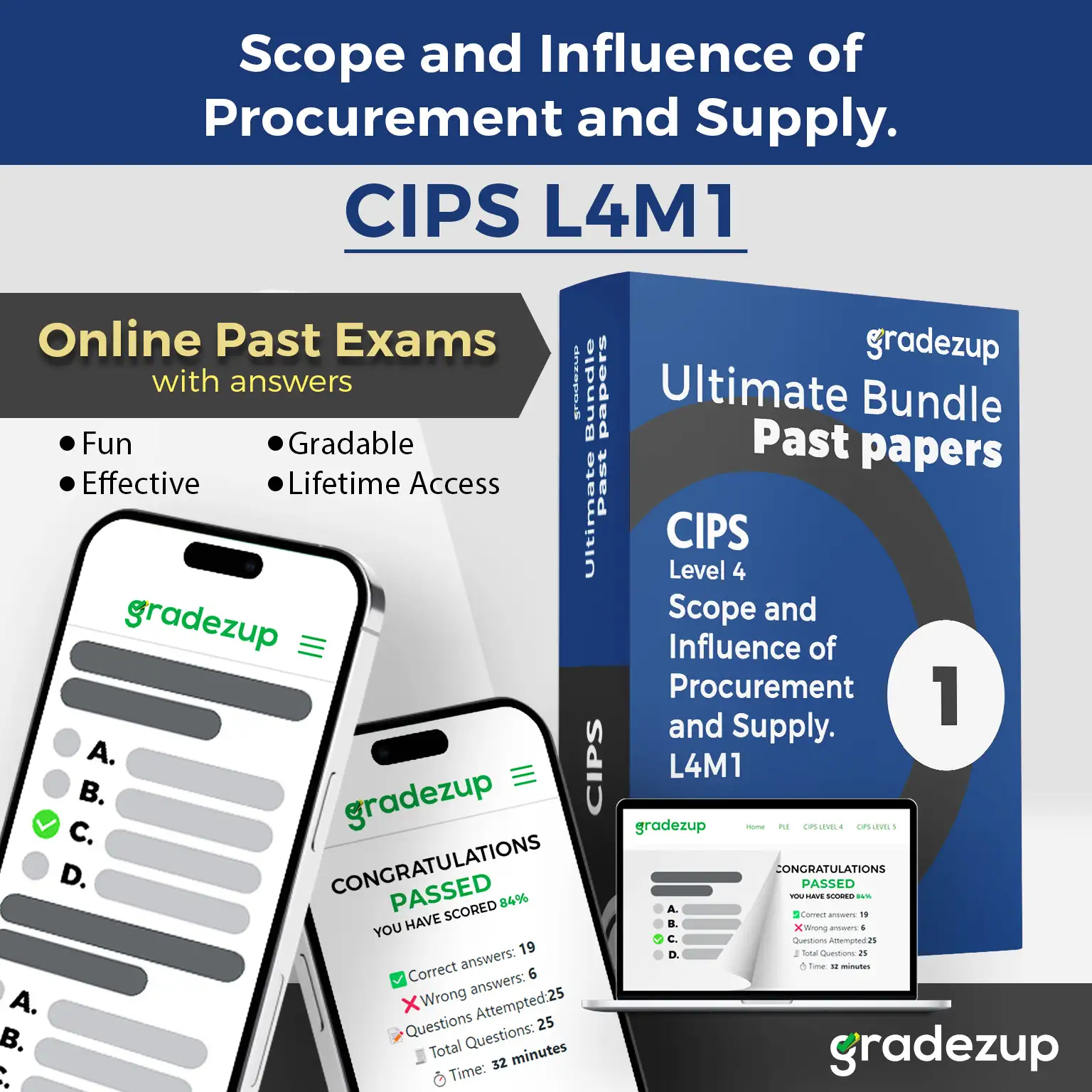
CIPS L4M1 Scope and Influence of Procurement and Supply is a core module of the CIPS Level 4 Diploma in Procurement and Supply, worth 12 credits. It is assessed by a 3-hour constructed-response (written) exam. It teaches you to identify the key stakeholders through the application of the sourcing process, the analysis of the procurement cycle and the evaluation of the influence procurement and supply has as a source of added value for the organisation.

Practice papers
20
Questions
80+
Exam length
3 h
Credits
12
Sale!

CIPS level 4 · 20 practice papers · 80+ questions

Original price was: $ 9.99.Current price is: $ 4.99.

Prepare for the CIPS Diploma in Procurement and Supply with ease. Failing and retaking exams can be costly, but fret no more. Our meticulously crafted set of questions is designed to assist you in acing your exam on your first attempt. This bundle includes  lifetime access to newly uploaded papers.

📲 Join our free WhatsApp channel: an exam question every day.

FreeStart practice

This course includes

  • 📝20 timed practice papers
  • ✓80+ exam-standard questions
  • ⚡Instant auto-marking & worked answers
  • ⏸Pause & resume any paper
  • 📊Track your scores over time
  • 📱Works on any device
Already purchased but can’t access your course? Restore access

Your papers live in your account, so the first step is to sign in — using the same email address you paid with. If you checked out as a guest and have never made an account, create one on that address and everything you bought appears automatically.

Sign in or create your account

Community polls

Vote to see how other learners answered.

Loading polls...

What the L4M1 syllabus covers

The official L4M1 syllabus has 4 learning outcomes. Every Gradezup L4M1 paper is written to these outcomes and their assessment criteria.

1.0 Understand and analyse the added value that can be achieved through procurement and supply chain management

  • 1.1
    Compare the concepts of procurement and supply chain management
    Key topics (6)
    • Definitions of procurement, supply chains, supply chain management and supply chain networks
    • Compare the role and function of supply chain management with procurement
    • Definition and function of supply chain tiering
    • Definition and issues related to complex supply chains
    • Definitions of logistics and materials management
    • Definitions of waste management and closed-loop recycling
  • 1.2
    Analyse the different sources of added value in procurement and supply
    Key topics (5)
    • The five rights of procurement
    • Defining total life cycle costs or whole-life asset management
    • Achieving five rights of procurement from external suppliers
    • Other sources of added value: innovation, sustainability and market development
    • Defining value for money
  • 1.3
    Describe the categories of spend that an organisation may purchase
    Key topics (7)
    • Typical breakdown of organisational costs represented by procurement of goods, services and constructional works
    • Stock and non-stock procurement
    • Direct and indirect procurement
    • Capital purchases and operational expenditures
    • Services procurements
    • Utility procurement
    • Commodity procurement
  • 1.4
    Differentiate the stakeholders of procurement or supply chain functions
    Key topics (3)
    • Definition of stakeholders
    • Examples of stakeholders of a procurement and supply chain function
    • Mapping stakeholders for a procurement and supply chain function

2.0 Understand and analyse the key steps when procuring goods or services

  • 2.1
    Explain each stage of the CIPS Procurement Cycle
    Key topics (2)
    • CIPS Procurement Cycle: pre-contract award stages (stages 1-8 of the CIPS Procurement Cycle) for generic procurement and supply activities
    • CIPS Procurement Cycle: post-contract award stages (stages 9-13 of the CIPS Procurement Cycle) for generic procurement and supply activities
  • 2.2
    Analyse each stage of the CIPS Procurement Cycle in relation to adding value
    Key topics (2)
    • The purpose and added value created at each pre-contract award stage (stages 1-8) of the CIPS Procurement Cycle
    • The purpose and added value created at each post-contract award stage (stages 9-13) of the CIPS Procurement Cycle
  • 2.3
    Explain how electronic systems can be used at different stages of the CIPS Procurement Cycle
    Key topics (3)
    • Definition and function of e-requisitions, e-catalogues, e-auctions, e-tendering and online supplier evaluation systems
    • The application of electronic systems at each pre-contract award stage (stages 1-8) of the CIPS Procurement Cycle
    • The application of electronic systems at each post-contract award stage (stages 9-13) of the CIPS Procurement Cycle
  • 2.4
    Analyse the relationship between policy and process compliance and required outcomes
    Key topics (2)
    • Organisational and contextual drivers for structured procurement and supply processes
    • Understanding and balancing the relationship between policy and process compliance with securing added value and customer service outcomes in different contexts

3.0 Understand and analyse aspects of organisational infrastructure that shape the scope of procurement and supply chain functions

  • 3.1
    Explain aspects of corporate governance impacting the procurement or supply chain function
    Key topics (5)
    • Conflicts of interest
    • The need for documented policies and procedures for procurement
    • Organisational accountability and reporting for procurement roles and functions
    • Code of ethics in procurement and supply: CIPS Code of Ethics and ILO (International Labour Organization) core conventions
    • The CIPS Code of Conduct
  • 3.2
    Analyse the impact of organisational policies and procedures on procurement and supply
    Key topics (3)
    • Topics included in procedures for procurement and supply: responsibilities for procurement, regulations relating to competition, levels of delegated authority, responsibilities for the stages of the sourcing process, invoice clearance and payment
    • The use of procurement policies, procurement strategies and procurement manuals
    • The involvement of internal functions and personnel in the procurement process
  • 3.3
    Examine the different structures of a procurement or supply chain function
    Key topics (3)
    • The role and status of procurement and supply chain management within different organisations
    • The use of centralised and decentralised structures
    • The use of hybrid structures in procurement and supply chain functions
  • 3.4
    Explain the common IT systems that can be used by a procurement or supply chain function
    Key topics (5)
    • P2P systems
    • Systems for inventory management
    • Enterprise resource planning (ERP)
    • Communications systems for internal and external use
    • Systems used to support e-sourcing, e-tendering and e-auctions

4.0 Understand and analyse the need for compliance with requirements when undertaking procurement activities in different sectors

  • 4.1
    Classify different economic and industrial sectors
    Key topics (2)
    • Economic classifications including public and private sectors, charities, not-for-profit and third sector
    • Industrial classifications and sectors such as manufacturing, retail, construction, financial, agriculture and service
  • 4.2
    Analyse the impact of the public sector on procurement and supply chain activities
    Key topics (3)
    • Objectives of public sector organisations: improving services, supporting communities and social value, and equality, diversity and inclusion
    • Regulations that impact on procurement and supply chain operations
    • Role of competition, public accountability and value for money in public sector procurement and supply activities
  • 4.3
    Examine the impact of the private sector on procurement or supply chain activities
    Key topics (3)
    • Objectives of private sector organisations: market share, shareholder value, environmental, social, governance and economic viability
    • Regulations that impact on procurement and supply chain operations
    • The importance and role of an organisation's branding in procurement and supply activities
  • 4.4
    Examine the impact of the not-for-profit or third sector on procurement or supply chain activities
    Key topics (3)
    • Objectives and principles of the not-for-profit or third sector
    • Regulations that impact on procurement and supply chain activities in charity and third sectors
    • Need for procurement and supply activities to align with organisation context mission and objectives

From the official CIPS L4M1 syllabus.

Peer Review Dashboard NEW

Review other students' quiz submissions and track your own submission status across all quizzes.

Guest Access: You can review 1 submission and vote on 1 poll per month. Sign in for full access.

Submissions Available for Review

Select a submission from any quiz to claim and review. You cannot review your own submissions.

Loading available submissions...

Review Submission

Community polls

Loading polls...

Frequently asked questions

  • What is CIPS L4M1?

    CIPS L4M1 Scope and Influence of Procurement and Supply is a core module of the CIPS Level 4 Diploma in Procurement and Supply, worth 12 credits. It is assessed by a 3-hour constructed-response (written) exam. It teaches you to identify the key stakeholders through the application of the sourcing process, the analysis of the procurement cycle and the evaluation of the influence procurement and supply has as a source of added value for the organisation.

  • Is L4M1 a core or elective module?

    L4M1 is a core module of the CIPS Level 4 Diploma in Procurement and Supply, worth 12 credits.

  • What type of exam is L4M1?

    L4M1 is assessed by a 3-hour constructed-response exam, where you write extended answers to the questions set.

  • What is the L4M1 pass mark?

    Constructed-response exams are graded: 50% is a Pass, 60% a Merit and 75% a Distinction.

  • How many L4M1 practice papers are there?

    Gradezup has 20 timed L4M1 practice papers with 80+ questions, written to the official syllabus, with model answers to compare against. At least one paper is free to try, no payment needed.

  • Are these the official CIPS L4M1 past papers?

    No. CIPS does not publish its live exam papers. Gradezup papers are original exam-style practice papers written to the official L4M1 syllabus and modelled on the style and difficulty of the real exam.

  • What do I get when I enrol?

    20 timed practice papers, 80+ exam-standard questions in total, each one auto-marked the moment you submit, with a worked answer and the reasoning behind every option. Your scores are tracked across attempts so you can see what is improving.

  • Do I have to work through the papers in order?

    No. Every paper in CIPS L4M1 Scope and Influence of Procurement and Supply unlocks as soon as you enrol, so you can start wherever you are weakest and retake any paper as often as you like.

  • How long do I have access?

    Access does not expire. Once you enrol the course stays on your account, including any papers added to it later.

  • Can I pause a paper and finish it later?

    Yes. Any paper can be paused mid-attempt and resumed from the same question, which makes short practice sessions workable.

  • What device do I need?

    Any device with a browser — desktop, tablet or phone. There is nothing to install and nothing to download.

  • How close are these to the real CIPS level 4 exam?

    Every paper is written against the current CIPS level 4 syllabus and mirrors the structure, question style and difficulty of the real exam, so practising here rehearses the exam itself rather than the topic in the abstract.

  • What is peer review?

    Written answers cannot be auto-marked, so this course lets you submit yours for review by other learners working the same papers — and review theirs. Marking someone else against the rubric is usually the fastest way to see what an examiner is looking for.

Questions from students

No questions yet — ask the first one.

Reviews

There are no reviews yet.

Be the first to review “CIPS L4M1 Scope and Influence of Procurement and Supply”

Your email address will not be published. Required fields are marked *

Scroll to Top