1 free to try · 1 of 15 unlocked — enrol to open the rest
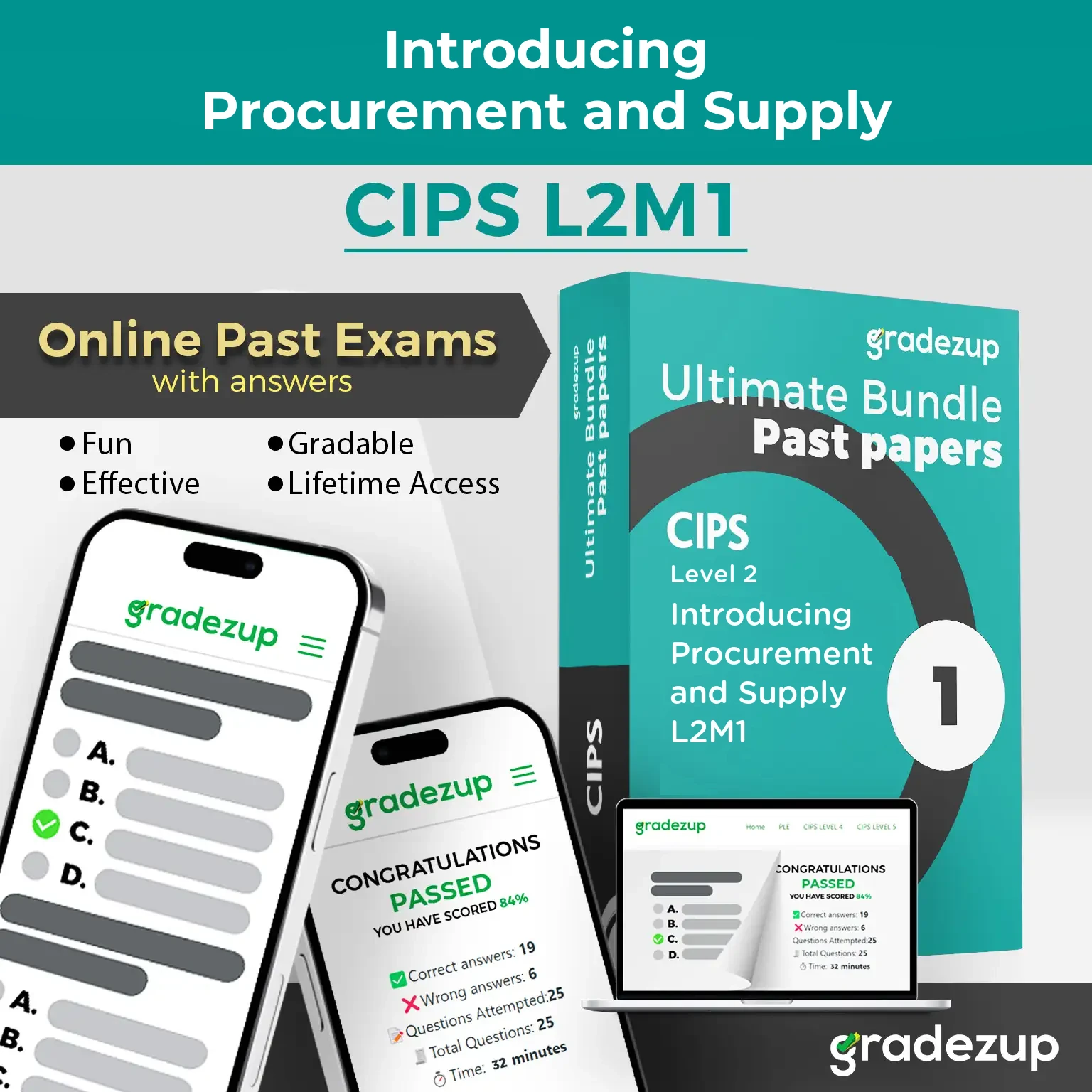
CIPS level 2
$ 9.99
What you will get
- Timed practice quizzes with exam-style questions
- Detailed explanations for every answer
- Instant feedback and scoring
- Practice on any device, anytime
- Full access with your Gradezup plan
📲 Join our free WhatsApp channel: an exam question every day.
This course includes
- 📝15 timed practice papers
- ✓375+ exam-standard questions
- ⚡Instant auto-marking & worked answers
- ⏸Pause & resume any paper
- 📊Track your scores over time
- 📱Works on any device
Already purchased but can’t access your course? Restore access
Your papers live in your account, so the first step is to sign in — using the same email address you paid with. If you checked out as a guest and have never made an account, create one on that address and everything you bought appears automatically.
Community polls
Vote to see how other learners answered.
Loading polls...
What the L2M1 syllabus covers
The official L2M1 syllabus has 6 learning outcomes. Every Gradezup L2M1 paper is written to these outcomes and their assessment criteria.
1.0 Understand the role of procurement and supply within organisations
-
1.1
Identify the common terms that describe aspects of procurement and supply
Key topics (3)
- Definitions of common terms such as procurement, purchasing, buying, supply chain, materials management, distribution, logistics and contract management
- Definitions of different types of procurements such as capital and revenue purchases, products, services, direct and indirect, outsourcing and insourcing
- Three sectors of activity: extraction of raw materials (primary), manufacturing (secondary), and services (tertiary)
-
1.2
Explain the roles and benefits of procurement and supply in organisations
Key topics (7)
- The typical proportion of costs accounted for by procurement of goods and services
- The roles of procurement and supply and procurement professionals
- Achieving value for money
- Sustainability in procurement and supply
- The roles of staff with devolved responsibilities for procurement of goods and services
- The roles of procurement and supply staff in making expenditures with suppliers
- The tiers of a supply chain
-
1.3
Define components of a supply chain
Key topics (6)
- Customers and their customers
- Customers and consumers
- Suppliers and their use of suppliers
- Tiers of a supply chain
- The global aspects of supply chains
- Examples of supply chains in action
2.0 Understand the organisational impact of procurement and supply
-
2.1
Identify how effective procurement impacts on organisational efficiency
Key topics (7)
- How effective procurement impacts on profitability
- Creating savings and improving efficiency
- Budgets and budget monitoring
- How effective procurement helps achieve targets
- Total costs of ownership criteria or whole life costs
- The different objectives of a procurement and supply function
- The creation of centralised, devolved and lead buying structures of procurement and supply functions.
-
2.2
Define the five rights of procurement and supply
Key topics (3)
- The five rights of procurement and supply
- Price, total cost, quality, timing, quantity and place
- Defining value for money
3.0 Know how products and services are received from suppliers and delivered to customers
-
3.1
Identify the delivery of products and services made by external suppliers
Key topics (3)
- The need for supplies of products and services from external suppliers
- Outsourced services
- Seeing suppliers as a part of a supply chain
-
3.2
Identify the delivery of products and services that organisations make to customers
Key topics (3)
- Defining products and services
- The customer role
- Seeing customers as a part of a supply chain
4.0 Know the stages of the sourcing process
-
4.1
Indicate stages of a sourcing process
Key topics (13)
- Identification of needs
- Producing specifications
- Requesting quotations
- Receiving quotations
- Assessing supplier quotations
- Making contract award recommendations
- Contract authorisation
- Order placement, blanket orders/frameworks and call off orders
- Performance and delivery
- Payment of suppliers
- Expediting deliveries
- Reviewing outcomes and processes
- Pre and post award stages of a sourcing process
5.0 Understand the need for the effective and efficient administration of purchases made with external suppliers
-
5.1
Describe and explain effective and efficient administration
Key topics (3)
- Defining administration
- Reviewing the steps taken to forming agreements made with suppliers
- Defining effectiveness and efficiency
-
5.2
Describe the administration of the pre contract stages of a sourcing process
Key topics (6)
- The creation of requisitions and requirements
- The use of specifications, key performance indicators (KPIs) and contract terms
- The creation of requests for quotations or invitations to tender
- The use of prequalification questionnaires
- The submission of quotations or tenders for requirements
- The assessment of quotations and tenders
-
5.3
Describe the administration of the award and post award stages of a sourcing process
Key topics (4)
- The creation of orders or tender award documentation
- Delivery notes and order acknowledgements
- Receiving invoices
- Invoice matching and dealing with non-compliances
-
5.4
Explain the need for approvals in the administration of procurement and supply
Key topics (5)
- Typical procedures for authorising budgets, requisitions, orders and tenders
- The separation of duties
- Contract recommendation and authorisation
- Levels of delegated authority for contracts
- Ensuring an efficient approval process
6.0 Know the importance of ethics and responsible procurement in organisations and supply chains
-
6.1
Identify good ethical practices and procedures within the context of the procurement and supply function
Key topics (6)
- Application of the CIPS Code of Conduct
- Details included in ethical codes affecting procurement and supply
- The use of ethical codes of practice
- The use of documented policies and procedures for the work of procurement and supply
- The principles of corporate governance
- Forms of bonded and exploitative labour that can exist in supply chains
From the official CIPS L2M1 syllabus.
Peer Review Dashboard NEW
Review other students' quiz submissions and track your own submission status across all quizzes.
Submissions Available for Review
Select a submission from any quiz to claim and review. You cannot review your own submissions.
Loading available submissions...
Please sign in to view and create your polls.
Community polls
Loading polls...
Frequently asked questions
What is CIPS L2M1?
CIPS L2M1 Introducing Procurement and Supply is a core module of the CIPS Level 2 Certificate in Procurement and Supply Operations, worth 6 credits. It is assessed by a 2-hour objective-response (multiple-choice) exam. It teaches you to identify the fundamental roles and activities, the systems, procedures, processes and contracts associated with the procurement and supply function.
Is L2M1 a core or elective module?
L2M1 is a core module of the CIPS Level 2 Certificate in Procurement and Supply Operations, worth 6 credits.
What type of exam is L2M1?
L2M1 is assessed by a 2-hour objective-response exam made up of multiple-choice questions.
What is the L2M1 pass mark?
You need 70% to pass an objective-response exam.
How many L2M1 practice papers are there?
Gradezup has 15 timed L2M1 practice papers with 375+ questions, written to the official syllabus, each marked the moment you submit with an explanation for every answer. At least one paper is free to try, no payment needed.
Are these the official CIPS L2M1 past papers?
No. CIPS does not publish its live exam papers. Gradezup papers are original exam-style practice papers written to the official L2M1 syllabus and modelled on the style and difficulty of the real exam.
What do I get when I enrol?
15 timed practice papers, 375+ exam-standard questions in total, each one auto-marked the moment you submit, with a worked answer and the reasoning behind every option. Your scores are tracked across attempts so you can see what is improving.
Do I have to work through the papers in order?
No. Every paper in CIPS L2M1 Introducing Procurement and Supply unlocks as soon as you enrol, so you can start wherever you are weakest and retake any paper as often as you like.
How long do I have access?
Access does not expire. Once you enrol the course stays on your account, including any papers added to it later.
Can I pause a paper and finish it later?
Yes. Any paper can be paused mid-attempt and resumed from the same question, which makes short practice sessions workable.
What device do I need?
Any device with a browser — desktop, tablet or phone. There is nothing to install and nothing to download.
How close are these to the real CIPS level 2 exam?
Every paper is written against the current CIPS level 2 syllabus and mirrors the structure, question style and difficulty of the real exam, so practising here rehearses the exam itself rather than the topic in the abstract.
What is peer review?
Written answers cannot be auto-marked, so this course lets you submit yours for review by other learners working the same papers — and review theirs. Marking someone else against the rubric is usually the fastest way to see what an examiner is looking for.
Questions from students
No questions yet — ask the first one.
You must be logged in to ask a question.
Reviews
There are no reviews yet.