
CIPS Level 5 Advanced Diploma in Procurement and Supply · Core module

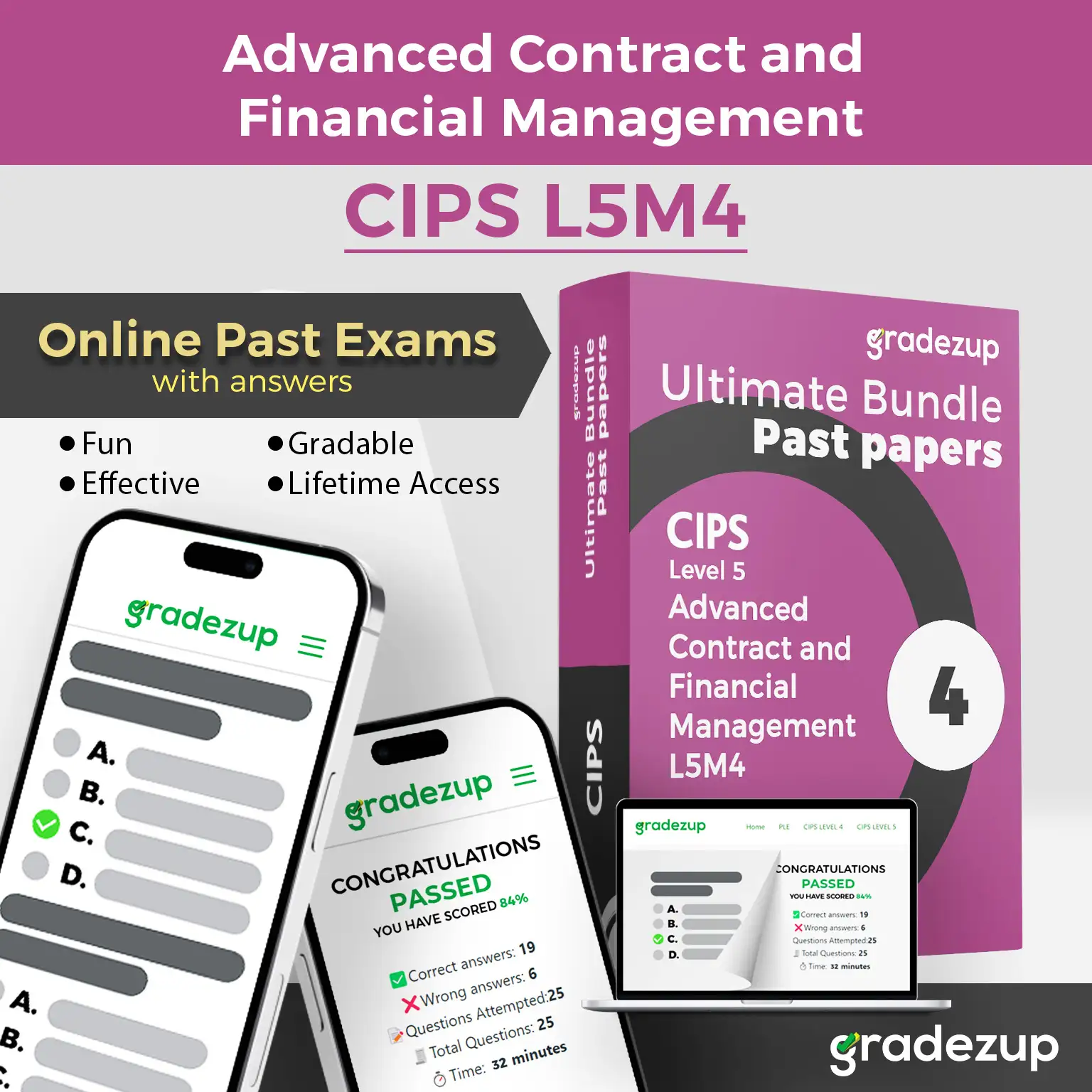
CIPS L5M4 Advanced Contract and Financial Management

CIPS L5M4 Advanced Contract and Financial Management is a core module of the CIPS Level 5 Advanced Diploma in Procurement and Supply, worth 12 credits. It is assessed by a 3-hour constructed-response (written) exam. It teaches you to develop financial measures to manage and improve contract performance.

Practice papers
20
Questions
81+
Exam length
3 h
Credits
12

CIPS level 5 · 20 practice papers · 81+ questions

$ 9.99

📲 Join our free WhatsApp channel: an exam question every day.

FreeStart practice

This course includes

  • 📝20 timed practice papers
  • ✓81+ exam-standard questions
  • ⚡Instant auto-marking & worked answers
  • ⏸Pause & resume any paper
  • 📊Track your scores over time
  • 📱Works on any device
Already purchased but can’t access your course? Restore access

Your papers live in your account, so the first step is to sign in — using the same email address you paid with. If you checked out as a guest and have never made an account, create one on that address and everything you bought appears automatically.

Sign in or create your account

Community polls

Vote to see how other learners answered.

Loading polls...

What the L5M4 syllabus covers

The official L5M4 syllabus has 4 learning outcomes. Every Gradezup L5M4 paper is written to these outcomes and their assessment criteria.

1.0 Understand and apply tools and techniques to measure and develop contract performance in procurement and supply

  • 1.1
    Assess the application of key performance indicators (KPIs) in delivering contract performance
    Key topics (7)
    • Effectiveness of supplier relationships
    • Cost
    • Quality
    • Delivery
    • Safety
    • Environmental, Social, and Governance (ESG) considerations
    • Product development
  • 1.2
    Evaluate methods of measuring and improving contract performance
    Key topics (7)
    • Sources of data and analysis of data in relation to cost, quality, delivery, safety, and ESG (Environmental, Social, and Governance) considerations
    • Measures supporting the improvement of ESG (Environmental, Social and Governance) considerations
    • Measures supporting the improvement of innovation in procurement and supply
    • Measures assessing product development time to market
    • Role of qualitative and quantitative data to measure and improve contract performance
    • Calculate and analyse return on investment for the use of data in measuring contract performance
    • Assess opportunities for data systems integration across supply chains
  • 1.3
    Examine approaches available for supplier contract performance
    Key topics (5)
    • Context and scope for supplier contract development
    • Supplier capability assessments
    • Learning, knowledge, and technology transfer between and across organisations
    • Collaborative product/service development: cross functional working, early supplier involvement, supplier networks, supplier co-ordination and supplier forums
    • Continuous improvement strategies, action plans, and reviews
  • 1.4
    Assess scope and developments to improve ESG (Environmental, Social, and Governance) considerations in supply chains
    Key topics (4)
    • Environmental measures
    • Social and social value measures
    • Governance measures
    • New supply chain finance

2.0 Understand and apply the concept of strategic sourcing

  • 2.1
    Assess the market factors that influence strategic sourcing
    Key topics (7)
    • Industry dynamics
    • Pricing behaviour
    • Financial data relating to suppliers
    • Market demand and supply factors
    • Business motivations, cost margins, and working practices of key suppliers
    • Internal stakeholder involvement
    • ESG (Environmental, Social, and Governance) considerations
  • 2.2
    Examine the assessment of sourcing options and trade-offs for strategic supply of products and/or services
    Key topics (7)
    • Contract type and duration
    • Competitive vs. non-competitive sourcing
    • Number of suppliers and vetting strategies
    • Marketplace competition and the role of competition regulators
    • Direct negotiation
    • Joint proposition improvement
    • Supply chain visibility
  • 2.3
    Analyse a strategic assessment plan for a key supplier using modelling and analytical techniques
    Key topics (11)
    • Capacity and capability
    • Planning
    • Quality control systems
    • Security
    • Technical expertise
    • Reputation and time established
    • Trading with competitors
    • Future expansion opportunities – partnership potential
    • Sensitivity analysis and calculation of investment outcomes based on a range of assumptions
    • Supplier performance based on financial data: calculate percentage change in revenues, costs, and profits
    • Sales forecast data and calculation of variances when comparing sales forecast data with the wider market

3.0 Understand and apply financial techniques that affect supply chains

  • 3.1
    Analyse how finance can impact on supply chains
    Key topics (5)
    • Role of financial management in supply chains
    • Options and risks of working capital funding and the role of credit insurance
    • Project funding options and assessment of cost of capital using weighted average cost of capital (WACC)
    • Medium and long-term financing options
    • Financing of investments, corporate financing options, and the role of dividends
  • 3.2
    Appraise methods for managing the volatility of currencies in supply chains
    Key topics (5)
    • Calculation of changes in indices to inform cost analysis
    • Fixed and floating exchange rates
    • Demand and supply factors in foreign exchange and the reasons for exchange rate volatility
    • Spot, forward, and derivative instruments in foreign exchange
    • Services provided by the banking sector in foreign exchange
  • 3.3
    Analyse methods for managing the volatility of commodities
    Key topics (5)
    • Types of commodities
    • Operation of commodity markets
    • Role of speculation in commodity markets
    • The operation of spot, forward, futures, and hedging in the buying and selling of commodities
    • The operation of Contract for Difference (CFD) in commodity markets

4.0 Analyse and apply financial and performance measures that can affect the supply chain

  • 4.1
    Assess financial measures that can be applied to the performance of the supply chain
    Key topics (4)
    • Calculation and evaluation of performance measures linked to cost, time, quality, and customer satisfaction
    • Calculation and evaluation financial measures of efficiency (ROCE), cash flow, sales growth, investment (IRR and NPV), and variances over time
    • Assessment of measures: stock turn, share yield, and earnings per share
    • Use, interpretation, and limitations of balanced scorecards
  • 4.2
    Examine the impact of stakeholder feedback on the supply chain performance
    Key topics (3)
    • Purpose of stakeholder feedback in developing supply chain performance
    • Devising metrics of performance including feedback from third parties and suppliers, and other stakeholders
    • Receiving feedback, reporting structures, and processes
  • 4.3
    Analyse approaches to benchmarking that can be applied to measuring supply chain performance
    Key topics (3)
    • Use and limitations of benchmarking in supply chains
    • Supplier involvement in performance improvement
    • Ethical approach the collection, storage, and use of benchmarking data

From the official CIPS L5M4 syllabus.

Peer Review Dashboard NEW

Review other students' quiz submissions and track your own submission status across all quizzes.

Guest Access: You can review 1 submission and vote on 1 poll per month. Sign in for full access.

Submissions Available for Review

Select a submission from any quiz to claim and review. You cannot review your own submissions.

Loading available submissions...

Review Submission

Community polls

Loading polls...

Frequently asked questions

  • What is CIPS L5M4?

    CIPS L5M4 Advanced Contract and Financial Management is a core module of the CIPS Level 5 Advanced Diploma in Procurement and Supply, worth 12 credits. It is assessed by a 3-hour constructed-response (written) exam. It teaches you to develop financial measures to manage and improve contract performance.

  • Is L5M4 a core or elective module?

    L5M4 is a core module of the CIPS Level 5 Advanced Diploma in Procurement and Supply, worth 12 credits.

  • What type of exam is L5M4?

    L5M4 is assessed by a 3-hour constructed-response exam, where you write extended answers to the questions set.

  • What is the L5M4 pass mark?

    Constructed-response exams are graded: 50% is a Pass, 60% a Merit and 75% a Distinction.

  • How many L5M4 practice papers are there?

    Gradezup has 20 timed L5M4 practice papers with 81+ questions, written to the official syllabus, with model answers to compare against. At least one paper is free to try, no payment needed.

  • Are these the official CIPS L5M4 past papers?

    No. CIPS does not publish its live exam papers. Gradezup papers are original exam-style practice papers written to the official L5M4 syllabus and modelled on the style and difficulty of the real exam.

  • What do I get when I enrol?

    20 timed practice papers, 81+ exam-standard questions in total, each one auto-marked the moment you submit, with a worked answer and the reasoning behind every option. Your scores are tracked across attempts so you can see what is improving.

  • Do I have to work through the papers in order?

    No. Every paper in CIPS L5M4 Advanced Contract and Financial Management unlocks as soon as you enrol, so you can start wherever you are weakest and retake any paper as often as you like.

  • How long do I have access?

    Access does not expire. Once you enrol the course stays on your account, including any papers added to it later.

  • Can I pause a paper and finish it later?

    Yes. Any paper can be paused mid-attempt and resumed from the same question, which makes short practice sessions workable.

  • What device do I need?

    Any device with a browser — desktop, tablet or phone. There is nothing to install and nothing to download.

  • How close are these to the real CIPS level 5 exam?

    Every paper is written against the current CIPS level 5 syllabus and mirrors the structure, question style and difficulty of the real exam, so practising here rehearses the exam itself rather than the topic in the abstract.

  • What is peer review?

    Written answers cannot be auto-marked, so this course lets you submit yours for review by other learners working the same papers — and review theirs. Marking someone else against the rubric is usually the fastest way to see what an examiner is looking for.

Questions from students

No questions yet — ask the first one.

Reviews

There are no reviews yet.

Be the first to review “CIPS L5M4 Advanced Contract and Financial Management”

Your email address will not be published. Required fields are marked *

Scroll to Top